
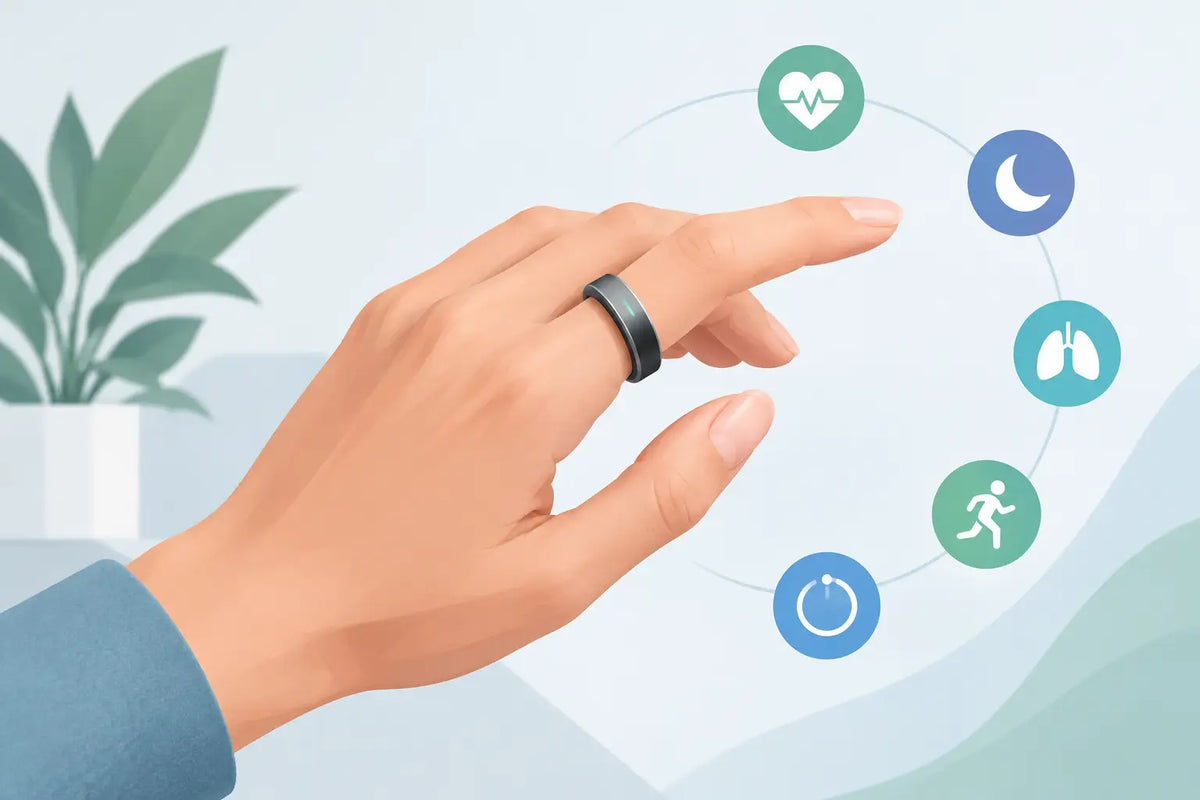
When you check your phone in the morning, you don't just want to know how many hours of sleep have passed. The real question is: How rested does your body actually feel? This is exactly where the future of health rings begins. They make health data visible right on your finger, without a display on your wrist, without conspicuous tracking, and without cluttering everyday life with technology.
A smart ring is small enough to feel like a normal accessory. At the same time, it can provide valuable insights into sleep, activity, heart rate, and recovery. This changes not only how we collect data. It changes how we listen to our bodies.
Why health rings are becoming increasingly relevant
Many people do not wear their smartwatch at night. Some are bothered by the display, while others consciously do not want to wear a watch on their wrist while sleeping. A health ring solves exactly this problem: It is discreet, lightweight, and significantly more comfortable for many wearers over many hours.
This is more than a design question. Health data is useful above all when it is collected regularly. A ring that matches your outfit during the day and is barely noticeable at night is more likely to be worn consistently. This creates patterns instead of snapshots: How does sleep quality change after a stressful day at work? What happens to recovery when training, alcohol, or late meals come together? And on which days do you actually feel better?
The strength lies not in interpreting every single value perfectly. It lies in making connections visible. Those who understand their habits can act more targeted - with small changes that remain realistic in everyday life.
The future of health rings: From tracker to personal compass
The future of health rings will not be defined by people collecting as many numbers as possible. It will be defined by data becoming more understandable and actionable. Instead of going through ten charts in the morning, users want to know: Should I push myself during training today or give my body a break? Was the night restful? Which routine is good for me?
Modern rings combine various signals to achieve this. Sleep duration alone is not enough. Rest periods, heart rate, movement behavior, and the regularity of the sleep rhythm also provide context. Individual measurements become a personal overview that adapts to your everyday life.
In the future, recommendations will become even more individual. Those who work late regularly, travel a lot, or work in shifts need different guidance than someone with a fixed daily rhythm. The ring does not become a know-it-all. It can be a quiet companion that recognizes trends and reminds you when a more conscious approach to sleep, exercise, or breaks might be useful.
However, this only works if the data is not understood as a judgment. A low sleep score is not a judgment of your own discipline. It is a signal to look closer. Maybe it was an exception. Maybe it shows a recurring pattern. Only by looking over several days and weeks does tracking become real orientation.
Sleep becomes the most important health metric
Sleep is the area where health rings unfold their greatest everyday utility for many. Because sleep problems are often not dramatic enough to immediately seek medical help, but noticeable enough to affect energy, concentration, and mood. A ring makes this invisible night more tangible.
This is not just about the question of when you go to bed and get up again. Consistency, interruptions, and personal recovery overnight are also relevant. Those who notice that sleep quality repeatedly deteriorates on certain days can test habits: an earlier last meal, less screen time, an evening walk, or a more consistent sleep rhythm.
The best insight is often surprisingly simple. Not every improvement needs a new routine with ten rules. Sometimes it is enough to recognize the one factor that regularly disturbs your own night. That is exactly why long-term data is so valuable.
More health without constantly looking at the display
Wearables have long stood for notifications, steps, and calories burned. Health rings set a different emphasis. They put quiet measurement in the foreground. No glowing display that vibrates during dinner. No constant look at the wrist. The data is there when it is needed - not as a constant distraction.
This suits people who want to use technology but do not want to be constantly interrupted by it. A ring can match a business outfit just as well as training or the weekend. Precisely this combination of functionality and understated design makes it more attractive than a classic sports watch for many.
The shape also plays a role. Sensors sit close to the skin on the finger and can capture body-proximal signals. However, how meaningful individual values are depends on many factors: from the correct fit, to the chosen model, to the duration of wear, and to individual physical differences. A well-fitting ring is therefore not a minor detail, but the basis for comfort and reliable measurements.
What a smart ring can - and cannot do
Health rings are powerful tools for self-observation. They help to better categorize developments in sleep, activity, and recovery. However, they do not replace a medical diagnosis, an examination, or professional advice.
This is an important difference, especially if values appear unusual or symptoms occur. A ring can provide clues and draw attention to changes. Those who repeatedly notice severe fatigue, heart problems, breathing problems, or other symptoms should not rely solely on wearable data, but seek medical advice.
The measurements themselves should also not create too much pressure. No sensor knows the entire context of a day. A stressful meeting, an infection, an unusual trip, or an intense training session can influence values. Good health routines are not created through perfection, but through a relaxed, regular look at your own development.
The future will be more personal and stylish
The market is developing away from pure fitness gadgets. Health rings are becoming lifestyle products for people who want to feel better without having to wear a technical statement. Colors, surfaces, and simple shapes are gaining importance because a ring is worn daily. It does not only have to be able to measure. It must also match your own style.
At the same time, the barrier to entry is decreasing. Those who are unsure which size fits expect simple digital size guides and fair purchase protection today. Especially with a product that is supposed to fit tightly on the finger, a ring measuring tool, free exchange for the wrong size, and a trial period create the trust necessary for a good decision.
Fitorb combines exactly this demand: health monitoring should not feel like a sacrifice or complicated technology, but like an elegant companion that you enjoy wearing. This is crucial, because the best functionality means little if a wearable lies in a drawer after a week.
What really matters when choosing
Those who want to buy a health ring should not look solely at a feature list as long as possible. The more important question is whether the ring fits your own life. Those who primarily want to understand their sleep need a comfortable fit for the night. Those who train actively should pay attention to everyday suitability and a clear evaluation of movement and recovery data.
The app is just as crucial. Data only helps if it is clearly presented and leads to traceable insights. A good application does not make a problem out of every deviation. It shows developments so that users can decide for themselves which habit they want to change next.
The material, battery life, and compatibility with your own smartphone are also part of the purchasing decision. The less friction in everyday life, the more likely the ring will become a real health ritual instead of just another technology product.
The most exciting question about the future is therefore not which sensors will fit into a ring next. It is whether technology helps people to deal better with themselves. If a quick look at your own patterns leads to going to bed earlier, taking more conscious breaks, or taking your body seriously after a stressful day, a health ring has already fulfilled its most important purpose.

Leave a comment
This site is protected by hCaptcha and the hCaptcha Privacy Policy and Terms of Service apply.