
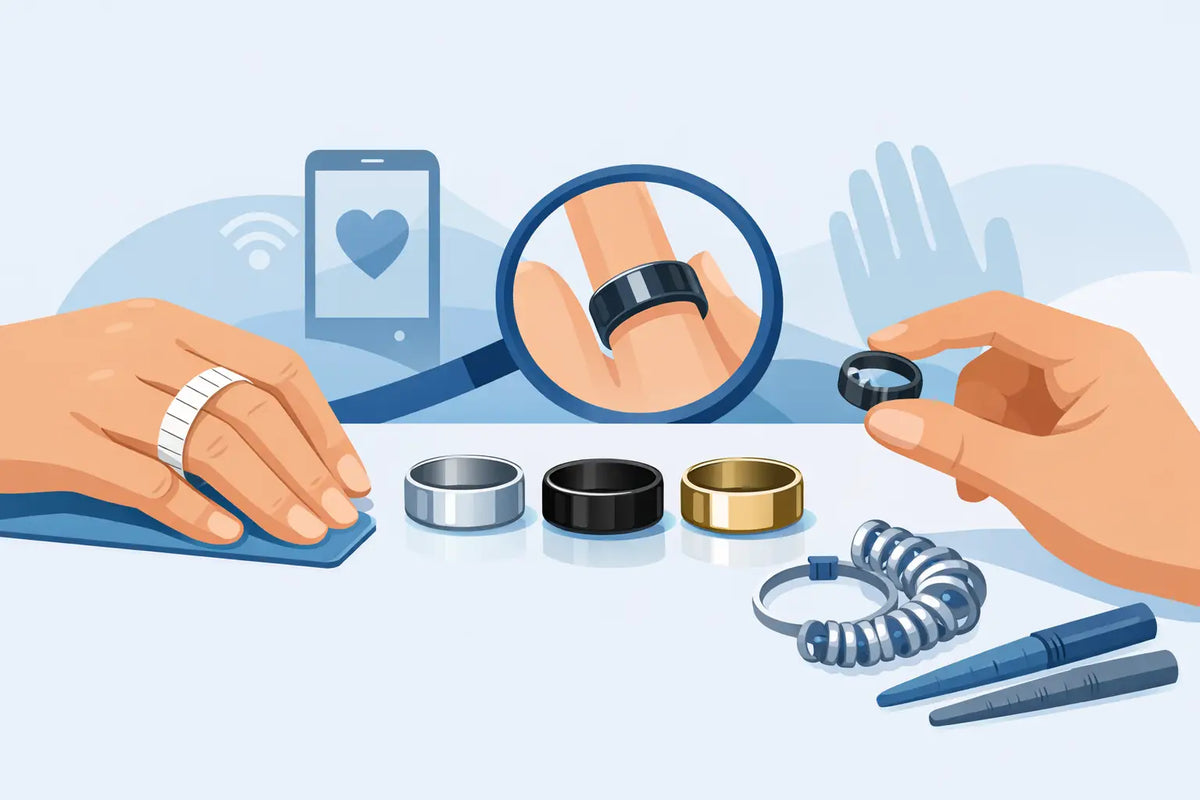
A smart ring should feel as though it has always been part of your everyday life. That is precisely why measuring your ring size before purchase determines far more than just comfort: A ring that fits properly stays comfortable while you sleep, does not interfere with typing, and can reliably collect your health data. Being too loose is just as problematic as being too tight—the right fit is the foundation of a good experience.
Unlike a fashion ring, a smart ring is often worn 24 hours a day. During exercise, at the office, at night, and on the go. Therefore, take a few minutes to choose the right size. It is the easiest way to prepare so that you will genuinely enjoy wearing your ring later.
Why ring size matters for a smart ring
Sensors on the inside of a smart ring require consistent, stable contact with the skin. If the ring constantly rotates, slips over the finger, or leaves a lot of air between the skin and the ring, this can impair data collection. A snug but comfortable fit helps the ring consistently collect data on sleep, activity, and recovery.
Snug does not mean tight. Your ring may offer slight resistance at the knuckle when you take it off, but it should never press against your skin, cause numbness, or leave a pulsating sensation. Especially at night, many people immediately notice whether the size is truly suitable for everyday wear. A ring that you consciously notice because it is uncomfortable will quickly end up in a drawer.
Fingers also change throughout the day. Heat, movement, salty food, exercise, or prolonged sitting can cause your hands to swell slightly. A size that appears perfect in the morning may feel tighter in the evening. That is precisely why you should not measure in a hurry.
How to measure your ring size correctly before purchase
It is best to measure your finger in the afternoon or evening. At this time, its circumference is more likely to reflect its normal daytime size for many people than it is immediately after waking up. Your hands should be neither very cold nor overheated. After an intense workout, a hot bath, or on extremely warm days, it is worth waiting a little before making a final decision.
Repeat the measurement at two or three different times. This may sound like a small extra step, but it often saves an unnecessary exchange. If the results vary slightly, do not automatically choose the tightest option. What matters is which size securely encircles the finger and feels natural over several hours.
Choosing the right finger
Smart rings are often worn on the index, middle, or ring finger. Which finger is best depends on the shape of your hand, your daily routine, and your personal style. The index finger offers a stable position for many people and is well-suited for everyday wear. Some prefer the middle finger because the width of the ring feels particularly balanced there. A smart ring often sits more discreetly on the ring finger—although it may fit narrower there, depending on the hand.
Important: The left and right hands are rarely exactly the same size. If you want to wear the ring on your dominant hand, measure that finger precisely. If you work extensively with a mouse, tools, or dumbbells, the non-dominant hand may be more comfortable. There is no universally best choice—the best position is the one that consistently feels comfortable for you and fits your routine.
Do not measure only the finger circumference
For many people, the knuckle is wider than the part of the finger where the ring will sit. A measurement alone is therefore not always sufficient. The ring must slide over the knuckle without sitting loosely on the finger afterward.
If you are using an existing ring as a reference, make sure it fits comfortably on the same finger and hand. A ring from the little finger or the other hand is not a reliable reference. Furthermore, narrow fashion rings differ from wider smart rings: A larger surface area of material can feel tighter, even though the inner diameter is similar.
Which measurement method makes sense?
A digital ring measurement tool is the most convenient option if you are ordering online and have no prior experience with ring sizes. You can check your finger multiple times, compare different fingers, and make your decision in peace. Fitorb's digital ring measurement tool helps significantly reduce uncertainty about sizing even before purchase.
Alternatively, a well-fitting ring can serve as a guide. In this case, measure the inner diameter as straight as possible from edge to edge—not the outer diameter. Even a few millimeters can make a difference in ring size. A flexible measuring tape can also help, as long as it lies flat and is not pulled diagonally across the knuckle.
Improvised methods using strips of paper or string are better than pure guesswork, but they have limitations. Paper can stretch, a mark can slip, and a string can easily be pulled too tight. If you use this method, measure several times and compare the result with a size chart. If there are two sizes close together, how the ring feels when worn is more important than mathematical perfection.
How to identify the right size
A properly fitting smart ring can be slid over the knuckle with slight resistance. Afterward, it should sit securely without sliding back and forth during normal hand movements. It should retain its position when washing your hands, typing, or gently shaking your hand.
If the ring rotates slightly, this is not necessarily a problem. However, it should not constantly tilt or be so loose that you could lose it while drying your hands. Also pay attention to the inside: the orientation of the sensors is important for smart rings. A secure fit makes it easier to maintain the intended position.
A ring is too small if you can only get it over the knuckle by applying pressure, if it leaves deep marks, or if it feels uncomfortable after some time. It is too large if there is visible play, if it moves while walking or gesturing, or if it can be slipped off without resistance. A slight mark after wearing the ring may be normal. Pain, tingling, or a restricted sensation are not.
Avoid typical mistakes when choosing a size
The most common mistake is measuring only in the morning. At that time, fingers are often narrower than later in the day. It is also risky to choose a ring size because it fits someone else. Even with a similar build, finger shape, knuckles, and circumference can differ significantly.
Many buyers also use a very thin favorite ring as a reference. A smart ring is usually wider and therefore fits differently. If possible, try on a ring of comparable width or expect the larger surface area to feel more noticeable.
Choosing based on appearance alone can also lead to mistakes. A particular finger may look especially elegant, but it is not necessarily the most comfortable for sleeping, exercising, and moving throughout the day. Health tracking works best when you do not have to take your ring off constantly.
What to do if you are between two sizes?
If you are between two sizes, it depends on the shape of your finger. If you have a pronounced knuckle, you often need the size that slides over it securely—provided it does not fit loosely afterward. If your hands swell noticeably throughout the day, a little more room is usually more comfortable than a ring that presses against your skin in the evening.
If your ring base is significantly narrower than your knuckle, check very carefully whether the larger size will slip later. In this case, the finger you choose may be more important than the last decimal place of your measurement. Another finger may offer a more even fit and therefore a better foundation for everyday comfort.
A wrong decision does not have to make the purchase stressful. Free exchanges for the wrong ring size and a trial period provide additional peace of mind. Nevertheless, careful measurement is worth it: It shortens the path to the moment when your smart ring simply works—unobtrusive, stylish, and there exactly when your health data can help you move forward.
So take your measurements, but also test how it feels in everyday life: A ring that you barely notice in the evening and still enjoy wearing in the morning is usually the right ring for your health on your finger.



Leave a comment
This site is protected by hCaptcha and the hCaptcha Privacy Policy and Terms of Service apply.