
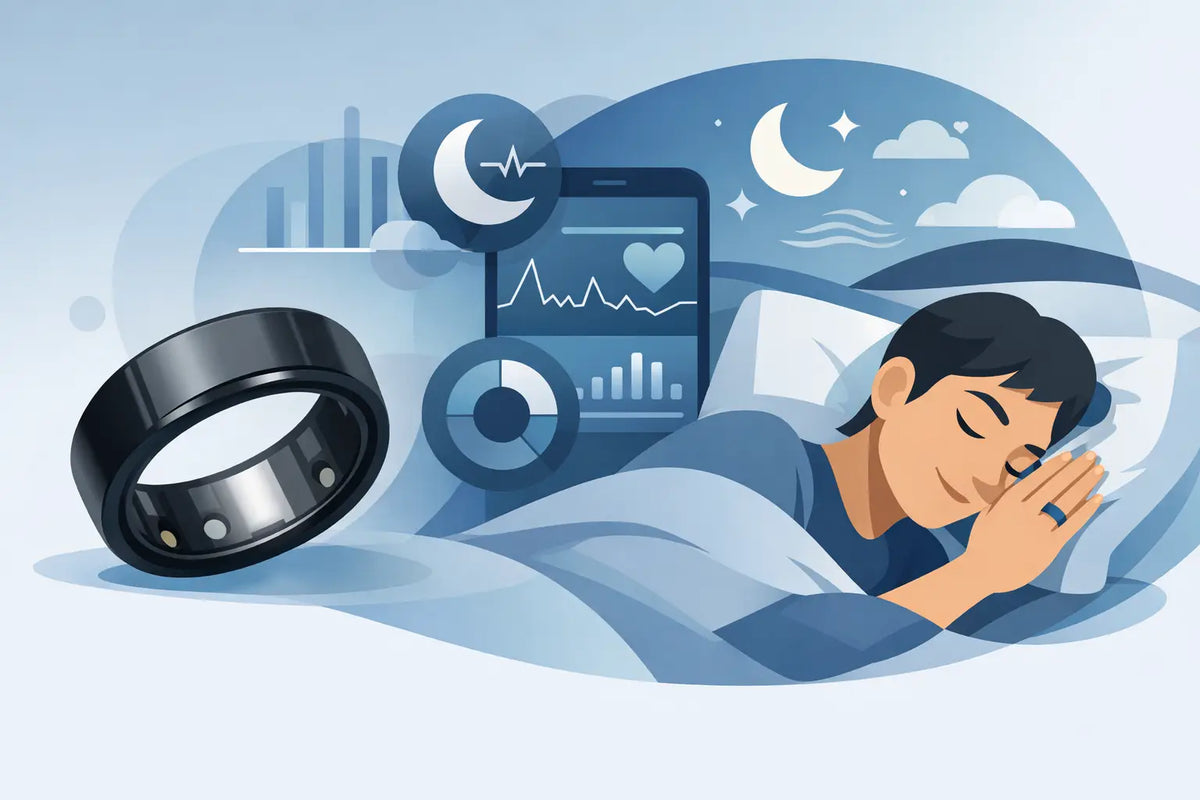
Anyone who wakes up in the morning and feels like they've been tossing and turning for seven or eight hours in bed quickly realizes: sleep is more than just time spent in the dark. This is exactly where smart ring sleep tracking becomes exciting. Instead of wearing a watch on your wrist, a ring discreetly measures how restful your night really was on your finger - and turns a vague gut feeling into tangible data.
What makes smart ring sleep tracking so attractive in everyday life
Many people know the problem with classic trackers: too big, too conspicuous, disruptive at night. A smart ring is the opposite. It sits discreetly on the finger, fits into everyday life, and doesn't stand out uncomfortably in the office or the bedroom. Especially for sleep tracking, this is a real advantage, because good measurements are only useful if the device is actually worn every night.
Then there's a point that many only notice after a few weeks: sleep data is only useful if it is collected regularly. Anyone who takes off their smartwatch in the evening because it pinches, shines too brightly, or simply doesn't fit their style gets gaps instead of clarity. A ring significantly lowers this hurdle.
For many health-conscious people, this is the real strength. No longer technology for technology's sake, but a discreet tool that fits into everyday life. That is exactly why a smart ring is so well suited to people who take their health seriously without wanting to live like they're in a fitness lab.
How smart ring sleep tracking works
The idea is simple: sensors in the ring capture body-close signals during the night. These usually include heart rate, heart rate variability, movement, and depending on the model, other values such as skin temperature or blood oxygen. From these signals, the app calculates patterns that allow conclusions about sleep duration, falling asleep time, waking phases, and recovery.
It is important to have a realistic view. No consumer wearable replaces a sleep lab. A smart ring does not provide a medical diagnosis, and it will not perfectly hit every sleep phase to the minute. But it often doesn't have to. For most users, the crucial thing is whether trends become visible. Do I sleep worse after late meals? Am I more restless after alcohol? Do I recover better if I consistently go to bed earlier?
That is exactly where the practical benefit lies. Smart ring sleep tracking helps less with a single night than with the pattern over weeks.
Which sleep data is really relevant
Many apps show a whole range of numbers, scores, and curves. That looks modern, but can also quickly confuse. In practice, a few core values are enough to make better decisions.
Sleep duration is the most obvious value, but not always the most important. Anyone who lies in bed for eight hours and often wakes up usually feels worse than someone with slightly less, but more restful sleep. That is why sleep quality is often more meaningful. It results from factors such as restlessness, interruptions, and the degree of recovery.
Heart rate variability is particularly exciting. Simply put, it shows how well your body gets into regeneration mode at night. A low HRV can indicate stress, overload, or poor recovery. The nighttime heart rate also provides clues. If it is unusually high, it can be due to late eating, alcohol, stress, or intense exertion.
Sleep phases such as light sleep, deep sleep, and REM are useful, but should not be overestimated. They help with classification, but in everyday life are more guidelines than absolute truth. Anyone who obsesses too much over every minute of deep sleep often loses sight of the essentials: How do you feel, and which habits visibly shift your values?
Why a ring is often more comfortable at night than a watch
Sleep tracking often fails not because of technology, but because of the wearing experience. A smartwatch can be practical in everyday life, but disruptive at night. The casing pinches, the strap sits uncomfortably, or you charge the watch exactly when it should actually be measuring. A ring is often the more relaxed solution.
It is lighter, more compact, and doesn't look like a screen on your body. For people who consciously opt for discreet technology, this is a real plus. Especially those who do not want to appear with a sporty watch at work all the time, or generally prefer minimalist design, get a significantly more stylish alternative with a smart ring.
This is not just a design bonus. Comfort increases the duration of use. And consistent use makes the data better. That is how simple it is in the end.
Reading smart ring sleep tracking correctly instead of driving yourself crazy
A common mistake is to look at every night in isolation. Bad score, bad mood. Good score, everything is great. Unfortunately, that is not how sleep works. It is influenced by work, training, nutrition, stress, sensory overload, and even room temperature. Individual outliers are normal.
It is more useful to look at patterns over at least two to three weeks. Maybe you always sleep worse on Sundays because the start of the week is already running in your head. Maybe it shows that late training extends your falling asleep time, even though you feel physically exhausted. Or you notice that just 30 minutes more sleep makes a clear difference in energy and concentration.
The data is intended to provide orientation, not create pressure. Anyone who starts chasing the perfect sleep quickly ends up with what many experience as sleep stress. Then self-optimization becomes an additional stress factor. That is why good trackers help not only with numbers, but also with understandable classification.
What a good smart ring for sleep tracking should bring
Not every ring automatically fits every everyday life. First and foremost, wearing comfort is crucial. If the size does not fit correctly, measurements become inaccurate or wearing it becomes annoying over time. That is why a simple size determination before purchase is more than just a nice service - it is the basis for good use.
Battery life also plays a bigger role than many think. Anyone who has to charge the ring constantly produces measurement gaps. An overview app is just as important. Sleep data should be quickly understandable and not look like a technology dashboard that only experts can decipher.
Then there is the question of material and design. A smart ring is not only worn at night, but all day. It should therefore look high-quality, sit comfortably, and fit your personal style. Health on the finger works best when technology does not look like a foreign body.
This is exactly where modern models come in, combining function and design. A ring should not look like a compromise, but like a product you like to wear.
For whom smart ring sleep tracking is particularly useful
If you often wake up tired, but do not know exactly why, a smart ring can quickly bring clarity. The same applies if you want to improve your everyday life based on data without constantly wearing a conspicuous wearable. This is especially practical for professionals with full calendars, fitness-oriented people in recovery phases, and everyone who wants to better understand their energy in everyday life.
Sleep tracking is less useful for people who easily put themselves under pressure through numbers or read every deviation as a problem. Then a relaxed approach to the data is needed. A ring is a helper, not a judge.
Anyone who is open to small adjustments usually benefits the most. Going to bed earlier, cutting out late caffeine, improving the evening routine, keeping the bedroom cooler - such changes seem unspectacular, but often make a surprisingly big difference in the data.
The real added value is not in measuring, but in changing
The best sleep analysis brings little if it only makes you curious, but changes nothing. The real value of smart ring sleep tracking arises when numbers become concrete habits. Maybe you realize that your best night does not come after a free Saturday, but after a structured workday without late scrolling. Maybe you see for the first time how strongly small decisions influence your recovery.
That is exactly why a smart ring is more than a nice gadget. It combines style, comfort, and health awareness in a way that remains practical for everyday life. Anyone who has no patience for clunky technology, but finally wants to understand their sleep better, will find a solution here that elegantly accompanies instead of disrupting. Fitorb stands exactly for this approach: modern health data, worn discreetly, and simply integrated into everyday life.
Good sleep does not start with perfect numbers, but with honest clarity about your own night - and sometimes a ring on the finger is enough for that.

Leave a comment
This site is protected by hCaptcha and the hCaptcha Privacy Policy and Terms of Service apply.