
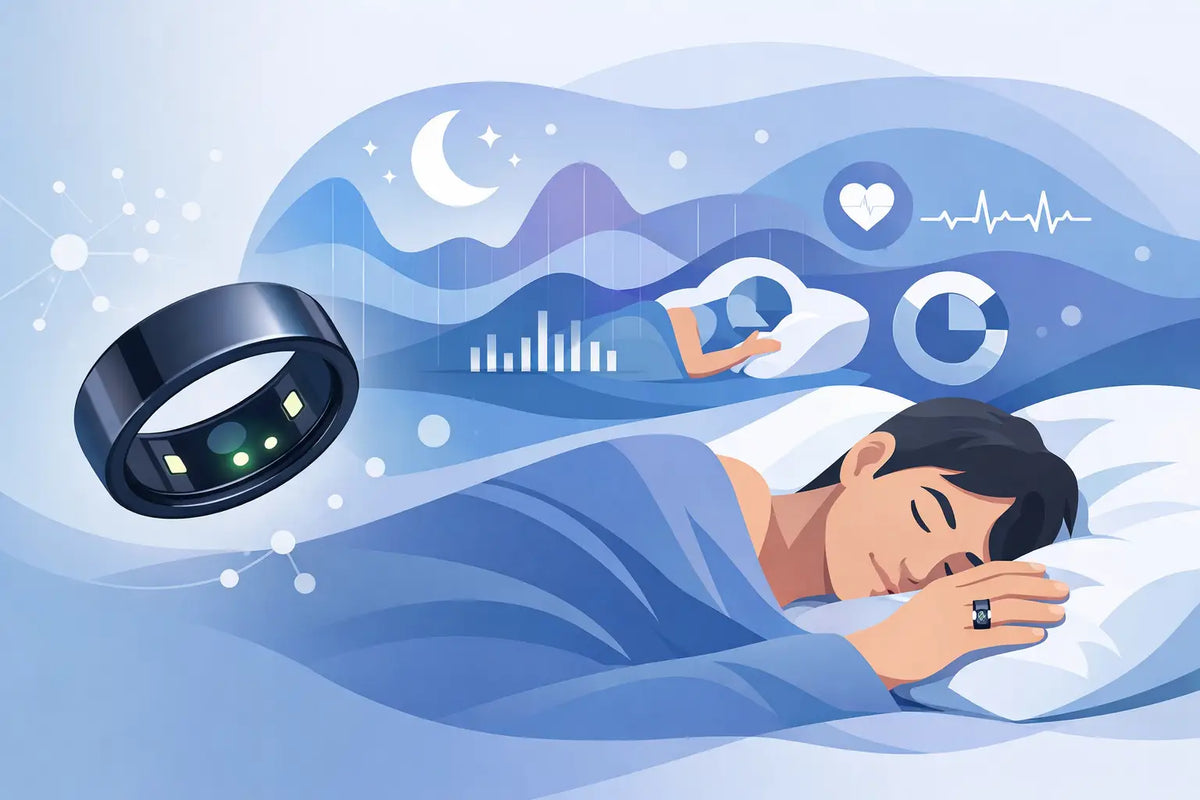
If you want to know not only whether you’ve slept long enough in the morning, but also how good your night’s sleep really was, you’ll quickly find yourself asking: How does a smart ring measure sleep data? This is exactly where many people find a ring more practical for everyday wear than a watch. It sits discreetly on your finger, barely gets in the way at night, and still continuously collects data to create a surprisingly accurate picture of your recovery.
How does a smart ring measure sleep data?
A smart ring doesn’t measure sleep by looking directly into your brain. It uses sensors that detect physical signals and calculate probabilities based on them. This may sound technical, but it’s quite simple in everyday use: while you sleep, the ring records your heart rate, heart rate variability, movement, skin temperature, and sometimes blood oxygen saturation.
The software uses these measurements to identify typical patterns. If your heart rate slows, you move less, and your temperature changes in a certain way, it indicates that you are asleep. When these patterns change, the ring can distinguish between light sleep, deep sleep, and REM sleep. The result is therefore not a clinical diagnosis, but an intelligent assessment based on several data points from your body at the same time.
This is exactly what makes the ring so compelling. It considers not only how long you spent in bed, but also the quality of your sleep. Spending eight hours in bed doesn’t automatically mean you’re well rested. A smart ring shows whether your body really entered restorative phases or whether your night was mostly superficial and restless.
The sensors behind the sleep data
The heart of sleep measurement is usually an optical sensor. It shines light into the skin and measures changes in blood flow. This allows it to derive your heart rate and often heart rate variability as well. These values are particularly interesting at night because the body shows clearer patterns while at rest than during the day.
A motion sensor is also included. It detects whether you lie still, turn over frequently, or get up during the night. This helps the system identify periods of wakefulness and restless intervals. Some rings also add temperature measurements to this data. Small changes in temperature can provide clues about recovery, exertion, alcohol, stress, or the onset of an infection.
Some models also incorporate blood oxygen saturation. This can be especially useful if your breathing fluctuates during the night. Nevertheless, a smart ring is not a substitute for a medical sleep study. It is a powerful tool for everyday use, but not a sleep lab on your finger.
The sleep data a smart ring displays
Most users first look at sleep duration. This is understandable, but it’s only part of the picture. The combined values are often more interesting, as they show how restorative your night’s sleep really was.
Typical information includes time to fall asleep, total sleep time, periods of wakefulness, and sleep stages. Many apps also display a sleep score or recovery score. These are based on a summary assessment of several data points. This lets you see at a glance whether your body recovered well during the night or not.
Trends are where things get interesting. A single bad night tells you very little. But if your ring detects over several days that your resting heart rate is rising, your deep sleep time is decreasing, and you are waking up more frequently, a pattern emerges. This is exactly what you can use to draw conclusions in everyday life—for example, whether late-night eating, alcohol, stress, or an irregular sleep schedule is hindering your recovery.
How accurate are the measurements really?
The honest answer is: quite good for everyday use, but not perfect every minute. Smart rings use algorithms, which are statistical models. They estimate sleep stages based on physical signals rather than measuring them directly. This means that quiet periods spent awake may be identified as sleep, or a restless night may be assessed differently than you subjectively experienced it.
Nevertheless, modern rings are often convincing at night because the finger is an ideal place for measurements. Blood flow can be reliably detected there, often more consistently than at the wrist. This is a real advantage over many smartwatches, which fit more loosely or are more likely to get in the way while you sleep.
In everyday use, consistency is more important than absolute perfection. If your ring measures night after night under similar conditions, changes will become visible. That is its real added value. The question is not whether your deep sleep lasted exactly 92 or 97 minutes, but whether your recovery is improving or worsening.
Why the finger works so well for sleep tracking
Many people do not want to wear a watch at night. It is larger, rests against the wrist, and is more likely to be perceived as uncomfortable while sleeping. A ring is more discreet. It is easier to forget you are wearing it, and that is exactly what makes it an advantage for continuous tracking.
Its proximity to well-perfused blood vessels in the finger is also an advantage. Optical sensors can often measure very accurately there if the ring fits properly. This often leads to stable results for heart rate and recovery trends. For people who want to use their data regularly, comfort is not a minor issue—it is crucial. A wearable is only truly useful if it is actually worn in everyday life.
What sleep data really offers in everyday life
Sleep tracking makes sense when data helps you make better decisions. You may notice that you have more trouble falling asleep after late workouts. Or that a glass of wine in the evening may seem relaxing, but it increases your heart rate at night and hinders your recovery. You are unlikely to notice such connections by intuition, but they often appear clearly in the data.
This is also helpful for busy professionals. If you feel tired in the morning, you may not know whether you simply didn’t sleep long enough or if you really didn’t recover well. A smart ring can help you assess your workload more realistically. This is especially useful if you want to better coordinate your training, work, and recovery.
This is exactly where a smart ring fits so well into modern everyday life. It provides health data without looking like a piece of sports equipment. This combination of style, comfort, and functionality makes it the more elegant choice for many.
What affects measurement quality
Even the best ring will only provide good data if a few basics are met. Fit is essential. If the ring is too loose, the signals will be less accurate. If it is too tight, it will be uncomfortable to wear. Reliable sleep data requires consistent contact with the skin, especially at night.
Habits also play a role. Alcohol, late heavy meals, medication, fever, or unusual stress can significantly change your body’s data. This is not a device error, but simply part of reality. That is exactly why you should never interpret sleep data in isolation. It is most useful when considered in the context of your own behavior.
If you are using a ring for the first time, you should also be patient. Many systems become more informative over several nights because they learn to better identify individual patterns. A single night is interesting. Two or three weeks are much more valuable.
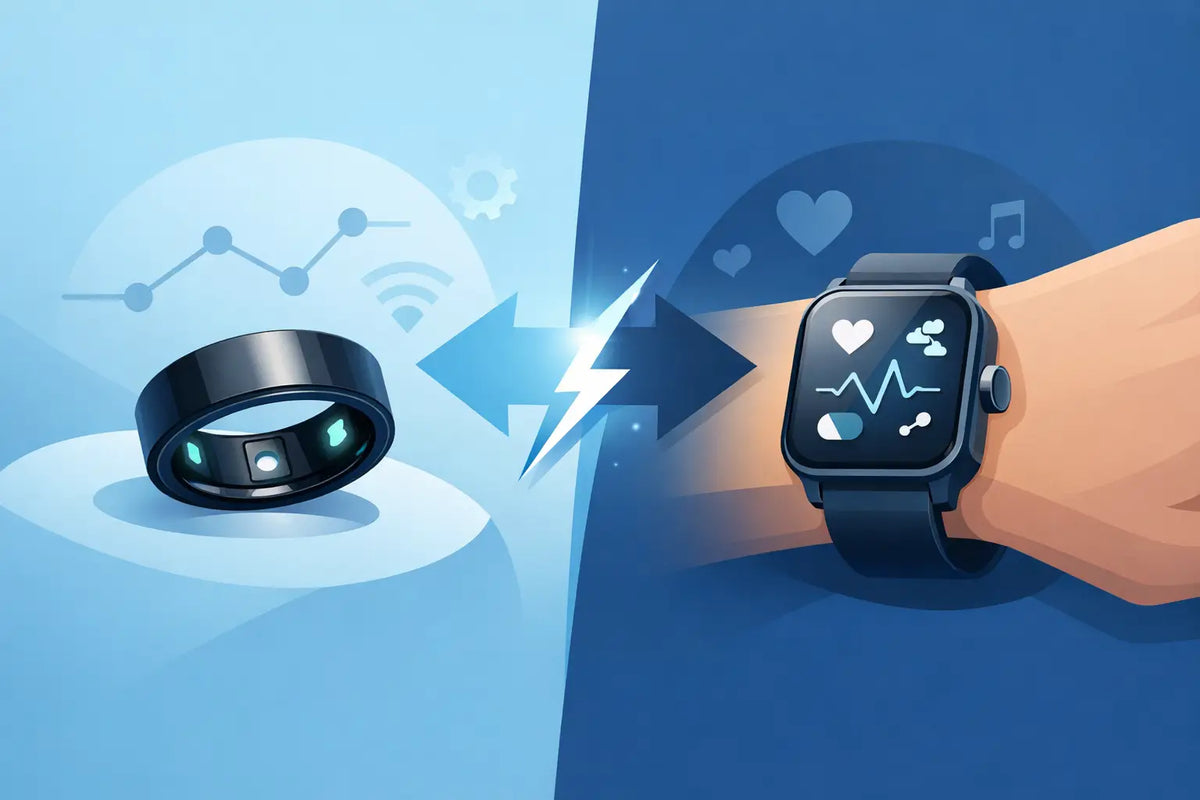
How a smart ring measures sleep data compared to a smartwatch
Both devices use similar principles, but the difference often lies in how they feel to wear and where they measure. Smartwatches are versatile, larger, and often equipped with a display. This is practical, but can be disruptive at night. A smart ring is more minimalist and designed for discreet, continuous wear.
This is a real advantage for sleep tracking. Many users wear a ring more consistently than a watch. More consistency usually means better long-term data. If you primarily want to understand your sleep, recovery, and daily health patterns, a ring is often the more comfortable solution. If, on the other hand, you need many training features directly on your wrist, a watch may be a better fit. It therefore depends on what is more important to you in everyday life.
What to look for in a smart ring for sleep tracking
Not every ring is automatically strong at sleep tracking. Look for reliable sensors, an easy-to-understand app, and data that is presented in a way that you can actually use. Data is only useful if it does not seem complicated.
Comfort is just as important. A ring that looks elegant, fits comfortably, and can be worn both day and night will simply be used more often. If you also feel reassured about sizing, exchanges, and the trial period, you will usually make your decision with greater peace of mind. That is exactly why a smart overall experience is often more important than pure technical specifications on paper—such as with the Fitorb Smart Ring Pro, which combines health monitoring with a discreet design and easy everyday use.
In the end, it does not matter whether a wearable generates as many data points as possible. What matters is whether it helps you understand your sleep better and use that insight to have calmer, stronger days.

Leave a comment
This site is protected by hCaptcha and the hCaptcha Privacy Policy and Terms of Service apply.