
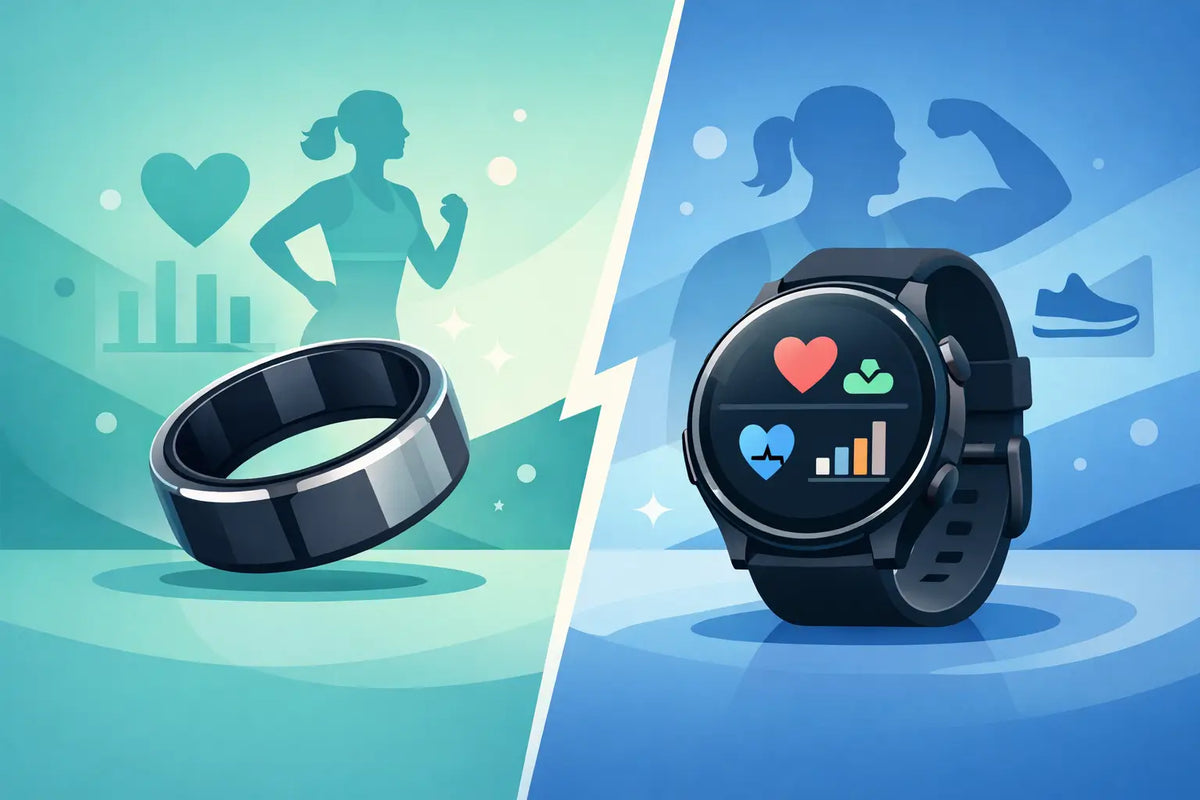
If you check your sleep data first thing in the morning but don't want to wear a bulky watch during the day, you quickly ask yourself the same question: Is a fitness ring alternative watch really the better choice—or is it ultimately just a matter of style? This is where practical utility is separated from habit.
Fitness Ring Alternative Watch - What Really Matters
Many people compare a smart ring and a watch solely on features. That's too narrow. In everyday life, something else often decides: Do you really wear the device every day, even at night, at the office, while eating, on the go, and during workouts? Because health data is only useful if the wearable doesn't end up in a drawer after two days.
On paper, a smartwatch often seems more versatile. It shows messages, has more workout views depending on the model, and comes with a larger display. This is practical if you want to actively interact with the device. At the same time, that is exactly the point where the watch becomes a hassle for many. It is visible, noticeable, and not always compatible with every outfit or situation.
A smart ring takes a different approach. It focuses more on discreet tracking than on screen time on the body. For people who want to keep an eye on sleep, recovery, heart rate, and daily activity without constantly wearing something on their wrist, this is often a much more comfortable way.
When a Watch Is the Better Choice
There are good reasons for a smartwatch. If you want to see live data while running, answer calls on your wrist, or actively control workouts during the session, a display is beneficial. The watch also remains the obvious choice for people who want many notifications directly on their body.
This is especially true for sports routines with clear real-time values. Pace, lap times, or navigation instructions can be grasped more quickly on a watch than through an app afterward. So if your focus is on direct workout control, the watch is often the more functional solution.
Still, there is a catch: Many users don't want this constant presence at all. More display on the body often means more interruptions. Anyone who buys their wearable primarily for health and less for digital stimulation will quickly find the watch to be too much.
Why the Ring Is the Smartest Alternative for Many
A ring feels different in everyday life than a watch. It is smaller, more discreet, and usually much easier to integrate into any routine. Especially at night, this makes a real difference. Many people dislike sleeping with a watch because it presses, bothers them, or simply remains noticeable. A ring, on the other hand, is often barely perceived after a short time.
For sleep tracking, this is a major advantage. Anyone who wants to improve their data at night needs a device that is actually worn every night. This is exactly where a ring impresses not with volume, but with everyday usability.
Then there is the design factor. A watch is always visible and makes a stronger style statement. This can be desired, but it doesn't have to be. A ring often fits more discreetly into business, leisure, and evening looks. For many, this is not a minor detail, but a deciding factor in the purchase. Health tracking should help, not dominate.
Fitness Ring Alternative to a Watch - For Whom Is the Switch Worth It?
The switch is especially worth it if you are currently dissatisfied with a watch, even though you like the idea of health data. Perhaps you only wear it during sports, take it off at night, or are annoyed by notifications on your wrist. In such cases, the ring is not simply a replacement, but often the more suitable form.
A ring is particularly useful for professionals who want a clean, minimalist setup. It is also often the more relaxed solution for people who want to optimize sleep, better understand stress patterns, or keep an eye on daily activity. It works more in the background and still delivers exactly the data that really matters in everyday life.
A ring is less suitable if you want to constantly check values during a workout. Then the display is simply missing. The ring is strong at capturing data, but less so at displaying it directly during movement. This is not a disadvantage for everyone, but it is a clear difference.
Not Just Technology - Comfort Also Decides
Wearables are often discussed in terms of sensors, but rarely in terms of wearing comfort. That is exactly where many devices fail. A product can have as many features as it wants—if it is annoying in everyday life, it will not be used consistently.
A watch can get in the way while typing on a laptop, press under tight clothing, or be uncomfortable while sleeping. Some get used to it, others never do. A ring is much more straightforward for many here. It sits compactly on the finger and interferes less with movements and routines.
Of course, a lot depends on the right size. A ring must fit well, otherwise it will quickly lose its comfort advantage. That is why an easy size finder is not a nice extra, but part of the product experience. Anyone who buys online wants certainty instead of guesswork.
Which Data Is Really Relevant in Everyday Life?
The more honest question is not: Which device can do more? But rather: Which values do you actually use? Many people do not need twenty workout metrics. They want to understand how they sleep, how active they are, and whether their body is signaling recovery or strain.
This is exactly what a ring is strong at. It focuses on health data that can easily be translated into habits. Slept poorly? Adjust your activity. Restless night? Plan more recovery. Little movement? Make the day more mindful. This type of feedback is often more relevant than another mini-display with even more options.
A watch scores points, on the other hand, if you want to see data in real time. The ring scores points if you want insights without further complicating your everyday life. Both can make sense. It depends on how you want to use technology.
Style, Habit, and Visibility
Wearables have long been more than just technology products. They are part of your look and your daily routine. That is exactly why the question of a watch or a ring is also a question of visibility. Not everyone wants to constantly show that they are wearing a tech device.
A ring appears more discreet. It is more suited to people who want to combine functionality with style without the product determining the entire look. A watch can appear sportier, more technical, or more striking. This is ideal for some, too prominent for others.
Especially if you want to wear a wearable around the clock, this restraint is a real advantage. The less the product bothers you, the higher the chance that you will use it permanently. And that is exactly where the real added value comes from in the end.
What Matters When Buying a Smart Ring Alternative
If you want to replace a watch, the ring should not only look nice. What matters are a comfortable wearing experience, reliable health features, an easy-to-understand app, and a purchasing process without uncertainty. Above all, the ring size is a frequent stumbling block. Anyone who does not offer a good solution here makes the switch unnecessarily complicated.
Service also plays a bigger role than many initially think. Free exchange for the wrong size, a fair trial period, and quick support provide exactly the certainty you need when buying a wearable. After all, hardly any other tech product fits as personally as a ring.
Brands like Fitorb address exactly this: health tracking should be elegant, simple, and suitable for everyday life—not technically overloaded and not visually intrusive. For many, this is the real progress compared to the classic smartwatch.
The Best Decision Is Often the One You Don't Constantly Notice
If you want maximum interaction, live views, and many smart additional features, a watch is still a strong choice. If, on the other hand, you are looking for a wearable that discreetly accompanies your health, remains comfortable to wear at night, and fits more easily into your style, the ring is usually the more convincing alternative.
So the better choice is not automatically the device with more features. It is the device you actually wear—reliably, comfortably, and without daily resistance. That is exactly when data becomes real habits. And that is exactly when health does not feel like additional technology, but like a better everyday life.


Leave a comment
This site is protected by hCaptcha and the hCaptcha Privacy Policy and Terms of Service apply.