
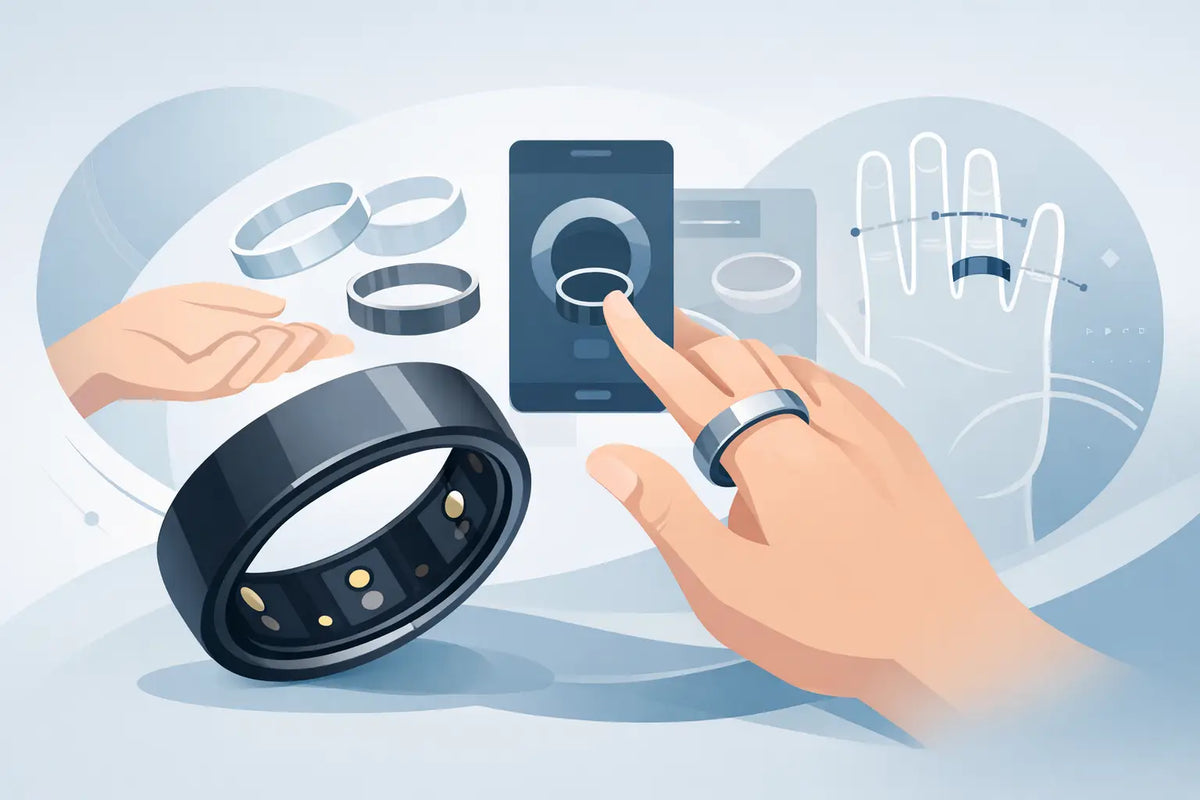
A smart ring can look as elegant as you like, but if it doesn't fit, it's more likely to end up in a drawer than on your finger. That's exactly why a good guide to smart ring fit is not just a nice extra, but the difference between precise health tracking and constantly readjusting it.
Why the right smart ring fit makes such a difference
With a smart ring, it's not just about making sure it fits over your finger somehow. It should sit comfortably, remain discreet in everyday life, and at the same time provide reliable data. This only works if the ring fits snugly enough to position the sensors properly against the skin, but not so tightly that it creates pressure points.
Too loose often means that the ring rotates, slips, or sits differently during movement than when at rest. Too tight is just as problematic. Then wearing it becomes uncomfortable, especially at night, in warm weather, or after a long day. The best fit feels secure without constantly drawing attention to itself.
Especially with smart wearables, this difference matters more than with classic jewelry. A regular ring can sit a little looser or more decoratively. A smart ring must also be functional. Anyone who wants to track sleep, activity, and well-being on their finger needs a size that can do both—look good and work reliably.
Smart ring fit guide: How to identify the right size?
You can tell the ideal size not by how tightly the ring fits. Quite the opposite. A well-fitting smart ring can be pulled over the knuckle with slight resistance, but remains securely in place during everyday use. It should not slide freely around the finger, nor should it feel like it is constricting the skin.
A simple practical test helps: Wear the ring for a few minutes and move your hand normally. Type on your smartphone, reach for a cup, and briefly clench your fist. If the ring remains comfortably in place without pressing or slipping, you are close to the right size.
The timing of the measurement is also important. Fingers change their circumference throughout the day. They can be narrower in the morning and slightly fuller in the evening. Heat, exercise, salt, hydration, and even stress all play a role. If you only measure once, you may quickly catch a moment that is not representative. It is better to measure several times at different times of the day.
Which finger is best for a smart ring?
That depends on your daily life. Many people wear their smart ring on their index, middle, or ring finger. These fingers often offer a good combination of comfort, stability, and sensor contact. What matters less is which finger is "best," but rather which finger on your hand provides a consistently comfortable fit.
If you type, exercise, or work with your hands a lot, one finger may feel more comfortable than another. Some prefer the ring on their ring finger because it looks more discreet there. Others prefer the index finger because the fit is more stable. Both can be right.
It is less practical to estimate the size based on another finger and then spontaneously change your mind. Even small differences in circumference significantly change the fit. If you want to wear the ring on a specific finger, you should measure that exact finger.
Right or left hand?
This is also no minor detail. In many people, the fingers of the dominant hand are slightly stronger. If you write and work with your right hand, your right hand often has slightly more circumference than your left. Therefore, you should not automatically assume that the same size will fit identically on both hands.
Why classic ring sizes are not always directly transferable
Many people assume that their known jewelry size will automatically also fit a smart ring. This may be true, but it is not always the case. Smart rings differ from classic models in their construction, width, and inner shape. A wide ring can feel tighter than a narrow one, even though the nominal size is the same.
In addition, with jewelry, you often tolerate a little wiggle room. With a smart ring, this wiggle room matters more because the sensors benefit from skin contact. That is exactly why it is worth not simply relying on old ring purchases, but specifically checking the size for a smart model.
How to measure correctly—without guesswork
A ring measuring tool or a special sizing set is the most reliable method. This allows you to simulate the eventual fit much more realistically than with improvised methods. Paper strips or strings may sound practical, but they often lead to inaccurate results because they behave differently than a real ring.
When measuring, pay attention to three things. First: Measure several times, not just once. Second: Test the finger in a normal everyday state, not immediately after exercise or in extreme heat. Third: Do not just judge whether the ring fits over the finger, but also how it feels when you wear it.
A digitally assisted ring measuring tool is particularly helpful if you are buying online and want peace of mind from the start. This is exactly where good services remove a lot of uncertainty from the process. Offering free exchanges for the wrong ring size makes the decision even more relaxed.
Common smart ring fit mistakes
The most common mistake is deliberately choosing a larger size "so that it is more comfortable." This sounds reasonable, but often leads to the ring moving around during everyday use, which compromises measurement quality. A smart ring should be comfortable, but not loose.
Almost just as common is the opposite: ordering too small because you want a particularly snug fit. This often only becomes noticeable after several hours. In the evening, at night, or on warm days, a snug fit can quickly become uncomfortable.
A third mistake is ignoring the knuckle when measuring. Some fingers are narrower at the base but have a more pronounced knuckle. The ring must therefore be able to do both—fit over the knuckle and then sit securely. If only one of these two points is met, the size is not ideal.
What about the season and temperature?
More than many people think. In summer, fingers tend to swell more, while rings often fit looser in winter. If you are right between two sizes, it is worth taking a realistic look at your daily life. If you are out and about a lot, exercise regularly, or often have warm hands, that should be taken into account. There is no universally perfect solution—only the one that is most suitable for your habits.
Comfort and data quality must go together
A smart ring is not a device you only put on for an appointment. It accompanies your sleep, exercise, work, relaxation, and routines. That is why long-term comfort matters. If a ring already has a borderline fit the first time you try it on, it will hardly become more comfortable after a long day.
At the same time, comfort should not come at the expense of functionality. If you constantly have to rotate the ring or deliberately push it to a certain spot, the fit is usually not quite right. A good fit works with your daily life, not against it.
That is exactly where the advantage of a well-thought-out purchasing process lies. When size guidance, a ring measuring tool, free exchanges, and a trial period work together seamlessly, choosing the right size is no longer a risk, but a simple step before the actual benefits.
What to do if you are between two sizes?
Then it is worth taking a close look at finger shape, the finger you intend to wear it on, and your usage habits. If the ring is designed rather wide or if you are prone to swelling, the larger size may be more comfortable. If your finger is evenly shaped and you want a more stable fit, the smaller size may fit better—provided it does not press.
What matters is how the ring fits over several hours, not just in the first thirty seconds. Therefore, if you are torn between two sizes, you should always choose the one that is more suitable for everyday use. The best moment is not when you unbox it, but when you hardly consciously notice you are wearing the ring after a short time.
A secure purchase begins with the size
Especially online, uncertainty about sizing is one of the most common reasons for hesitation. Understandably. No one wants to order a wearable and then hope that it somehow fits. That is why clear size guidance is not a minor detail, but part of a good product experience.
At Fitorb, this is exactly part of the experience: easy size determination, a digital ring measuring tool, and the assurance that the wrong size does not have to lead to the wrong decision. This noticeably lowers the barrier—especially for anyone buying a smart ring for the first time who has no interest in complicated follow-up questions or uncertainty.
In the end, the best fit is the one that makes you forget in everyday life that you are wearing technology—while your ring does exactly what you bought it for. When comfort, style, and a reliable fit feel right, an interesting gadget quickly becomes a permanent part of your routine.



Leave a comment
This site is protected by hCaptcha and the hCaptcha Privacy Policy and Terms of Service apply.