
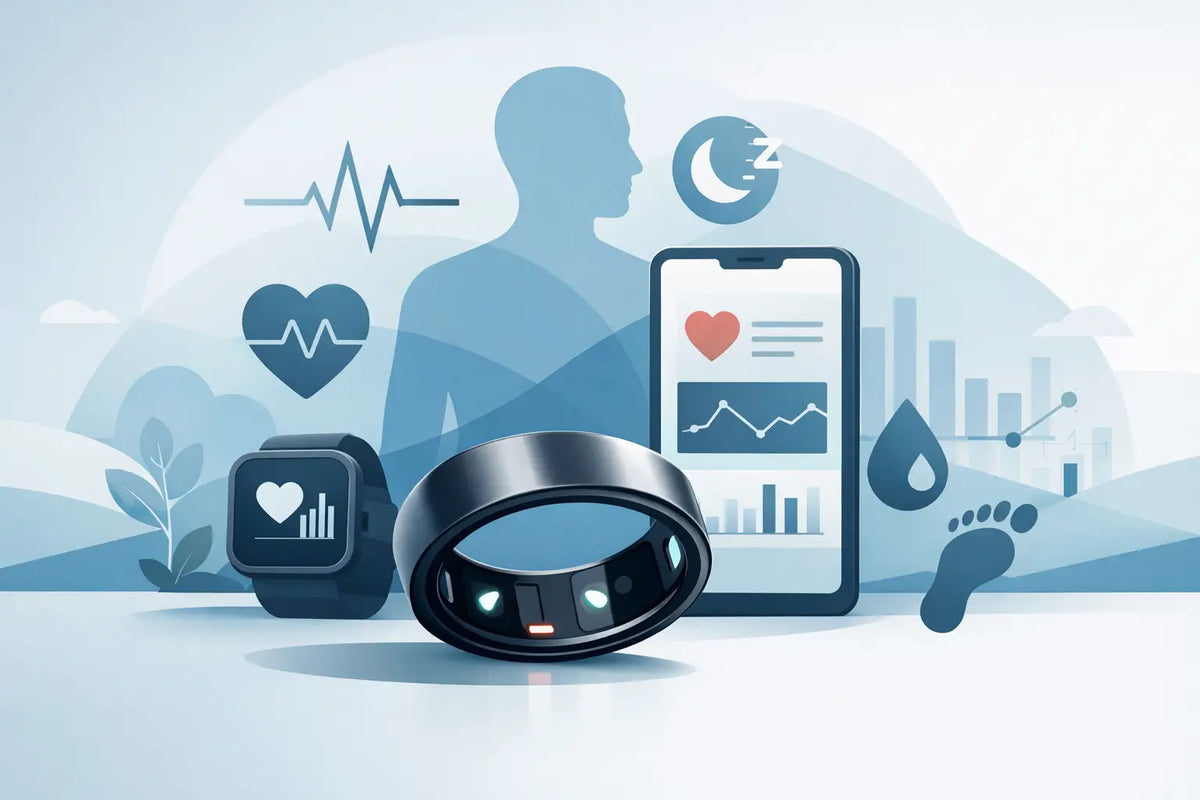
A smart ring for health in review must be able to do more than count steps. It should discreetly accompany you at night, provide understandable insights in the morning, and not be a distraction during the day. That is exactly its appeal: health data right on your finger, without a display, vibrations, or the constant distraction of a smartwatch.
For many people, a better sense of health does not begin with a strict training plan. It begins with an honest question: Do I really sleep soundly? Do I exercise enough? Why am I focused on some days and exhausted by the afternoon on others? A smart ring makes these patterns visible and helps turn data into practical everyday habits.
Smart ring for health in review: What matters?
A good health ring is not a medical diagnostic device and does not replace a visit to the doctor. Its value lies elsewhere: It brings recurring signals from sleep, activity, heart rate, and recovery into a clear connection. Instead of overestimating individual values, you see developments over days and weeks.
This is especially true for sleep, where the difference to many classic trackers becomes apparent. A ring is compact, light, and has no bright display on the wrist. Those who find watches disruptive at night often wear a ring much more consistently. And regular wear is crucial, because only then is data created that can be meaningfully compared with personal routines.
The best results are not achieved by looking at a single score. They are achieved when you recognize: After eating late, I sleep more restlessly. After an afternoon walk, I recover better. After several short nights, my resilience drops. A smart ring provides clues for this—the change in everyday life remains your decision.
Understanding sleep instead of just seeing sleep duration
Eight hours in bed does not automatically mean eight hours of recovery. A health ring can capture sleep phases, nighttime awakenings, heart rate, and other body-close signals. In the app, these are turned into clear evaluations that help you better understand your sleep quality.
Looking at regularity is particularly helpful. Those who go to bed at different times every evening often only notice through the data how strongly this affects their recovery. Even a short comparison between the work week and the weekend can be surprising.
Keep in mind: Sleep tracking is an orientation, not a reason for concern after a single restless night. The trend is what matters. If your values are lower over a longer period and you simultaneously feel tired, unfocused, or unbalanced, it is worth taking a closer look at your habits and seeking medical advice for persistent symptoms.
Recovery is more than a break
Modern rings not only capture movement but also rest periods. Values such as resting heart rate and heart rate variability can provide clues as to how well your body regenerates after exertion. This is interesting for athletes, but just as much for people with a full calendar, long workdays, or few predictable routines.
A low recovery value does not automatically mean you are not allowed to do anything. Perhaps a leisurely walk fits better on that day than an intense workout. Perhaps it is more sensible to let the evening wind down earlier. Good health data does not set rules; it gives you a more well-founded basis for decisions.
Capturing activity without constantly looking at the display
Many people want to move more but do not want to wear a watch that displays every message on the wrist. This is exactly where a smart ring plays to its strength. It accompanies steps, active times, and training in the background. You keep your smartphone in your pocket and check the app when it suits you.
The discreet format has another advantage: A ring fits business outfits, casual wear, and evening attire. Health monitoring does not have to look like a gym. Those who like to wear their wearable will also use it long-term—and long-term data is more meaningful than a motivated week in January.
However, a ring is not the perfect solution for every sport. During strength training with heavy dumbbells, kettlebells, or a close grip, it can be disruptive or get scratched. In such moments, many take it off and put it back on afterward. For everyday life, walks, sleep, and many endurance sessions, it remains a pleasantly understated alternative to the smartwatch.
Fit determines comfort and data quality
With a smart ring, size is no minor detail. If it fits too loosely, it can turn or slip off while washing your hands. If it fits too tightly, it becomes uncomfortable in everyday life—especially when fingers swell slightly due to heat, sports, or in the morning.
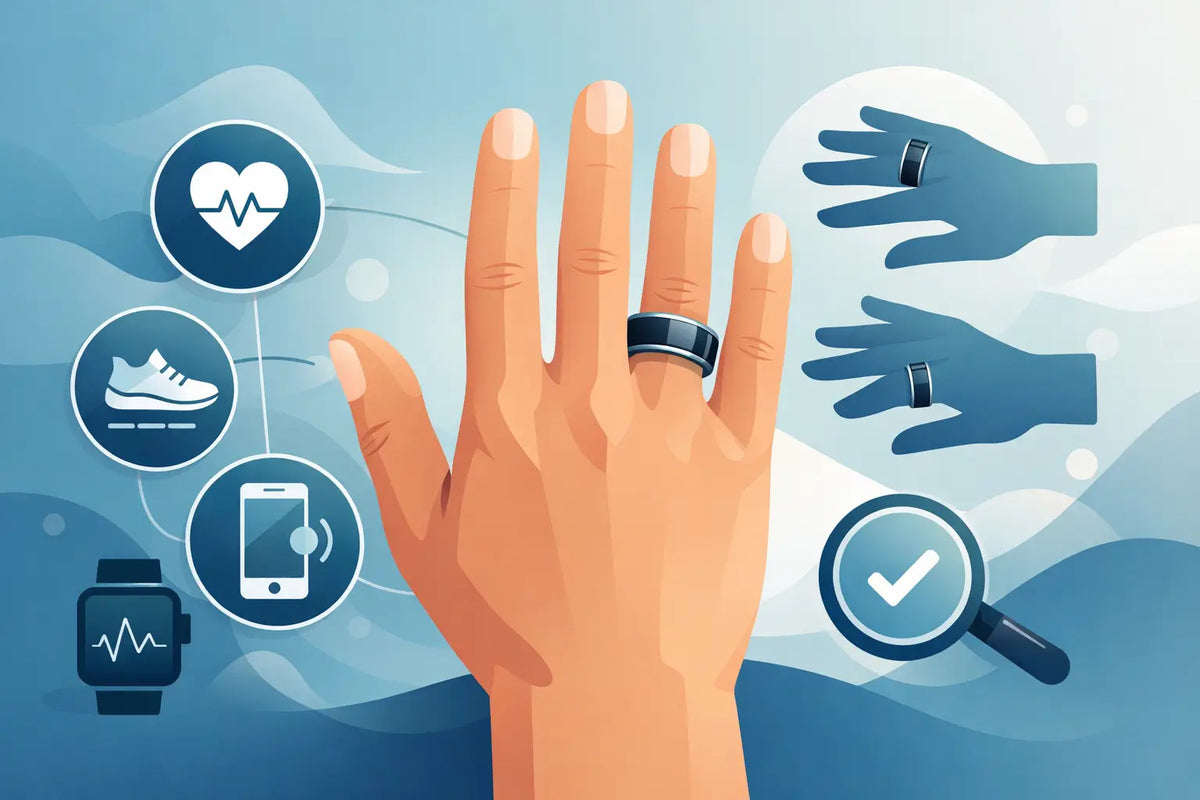
Ideally, the ring fits securely without digging in. It should be removable over the knuckle with slight resistance and not rotate freely during normal movements. Many wear a health ring on the index, middle, or ring finger. Which position fits best depends on your hand, your comfort, and the respective ring size.
Take time for finding the size and test the fit at different times of the day. A digital ring measuring tool or a size set removes uncertainty from the purchasing process. Fitorb additionally supports this decision with a free exchange for an unsuitable size. This is more than comfort: It increases the chance that the ring fits comfortably long-term and is used reliably.
What a good health ring should be able to do in everyday life
When comparing, it is not just the sensors on the data sheet that count. The entire user experience is crucial. Is the data prepared understandably? Is the app intuitive even without a technical degree? Does the design fit your style? And is there clear protection if the size or product does not convince you?
Pay attention to a high-quality, everyday-suitable material and a surface that feels pleasant. Multiple colors and style variants are not a superficial extra. They help make the ring part of your personal look instead of just seeing it as a technology product.
Battery life also deserves attention. A wearable is of little use if it constantly needs to be charged and fails exactly when you want to capture your sleep or a strenuous week. Less charging effort usually means more continuity—and thus a better data basis.
Data privacy and keeping expectations realistic
Health data is personal. Therefore, check before purchasing which data the app processes, which permissions are required, and whether the evaluations are clearly explained. Trust is not created by as many metrics as possible, but by traceable information and usage that feels good.
Just as important: No smart ring can interpret every bodily reaction flawlessly. Cold hands, a loose fit, tattoos at measurement points, intense movement, or individual physical differences can influence measurements. See the results as valuable trends, not as an indisputable judgment of your health.
For whom is a smart ring really worth it?
A health ring is particularly well suited for people who want to understand sleep and recovery better but do not want to wear a smartwatch. It is ideal for professionals who want to keep an eye on their stress and sleep rhythms, for fitness fans who want to plan regeneration more consciously, and for everyone who wants to combine discreet technology with modern design.
It is less suitable for people who want to see live values on a large display permanently during training. Those who need navigation, messages, calls, and apps directly on the wrist will probably be better served with a smartwatch. A ring follows a different approach: less distraction, more background knowledge about your body.
The best smart ring in the end is the one you forget in the morning and still like to evaluate in the evening. Choose a fit that feels natural, and give the data a few weeks. Then an elegant ring on your finger becomes a practical companion for more conscious days and more restful nights.


Leave a comment
This site is protected by hCaptcha and the hCaptcha Privacy Policy and Terms of Service apply.