

The question “which finger for a smart ring?” is about more than just looks. When the ring fits the right finger, it rests securely against the skin, allowing the sensors to measure more reliably and making it so comfortable that you’ll quickly forget you’re wearing it. If it’s too loose, it will spin. If it’s too tight, it will quickly become uncomfortable—especially at night or in warm weather.
A smart ring should elegantly support your health, not disrupt your daily routine. That’s why there is no single finger that is perfect for everyone. However, there is a clear recommendation and some simple rules to help you quickly find the ideal fit.
Which finger is best for a smart ring?
For most people, the index, middle, or ring finger is the best choice. These fingers usually offer enough surface area for a secure fit and ensure that the sensors on the inside of the ring maintain consistent contact with the skin.
The index finger is often the first choice. It is active in everyday life, the ring fits securely on it for many people, and it is easy to wear. Especially if you want to deliberately show off your smart ring as a modern accessory, it looks confident and stylish on the index finger.
The middle finger is a strong alternative if a ring on the index finger becomes noticeable when typing, gripping, or exercising. Many people find it well-balanced there: prominent enough for a reliable fit, but less intrusive during fine movements.
The ring finger can also work perfectly. It is often slightly slimmer and is especially suitable for anyone who prefers a more understated look. The only important thing is that the ring is not squeezed next to a very wide fashion ring. Two rings right next to each other can shift each other or trap moisture when washing your hands.
Why fit is more important than the hand
Whether you wear the ring on your right or left hand is generally less important than a secure, comfortable fit. Choose the hand that you feel less with in everyday life. Those who write, work with their hands, or lift weights with their right hand often prefer the left hand. Left-handed people frequently experience the exact opposite.
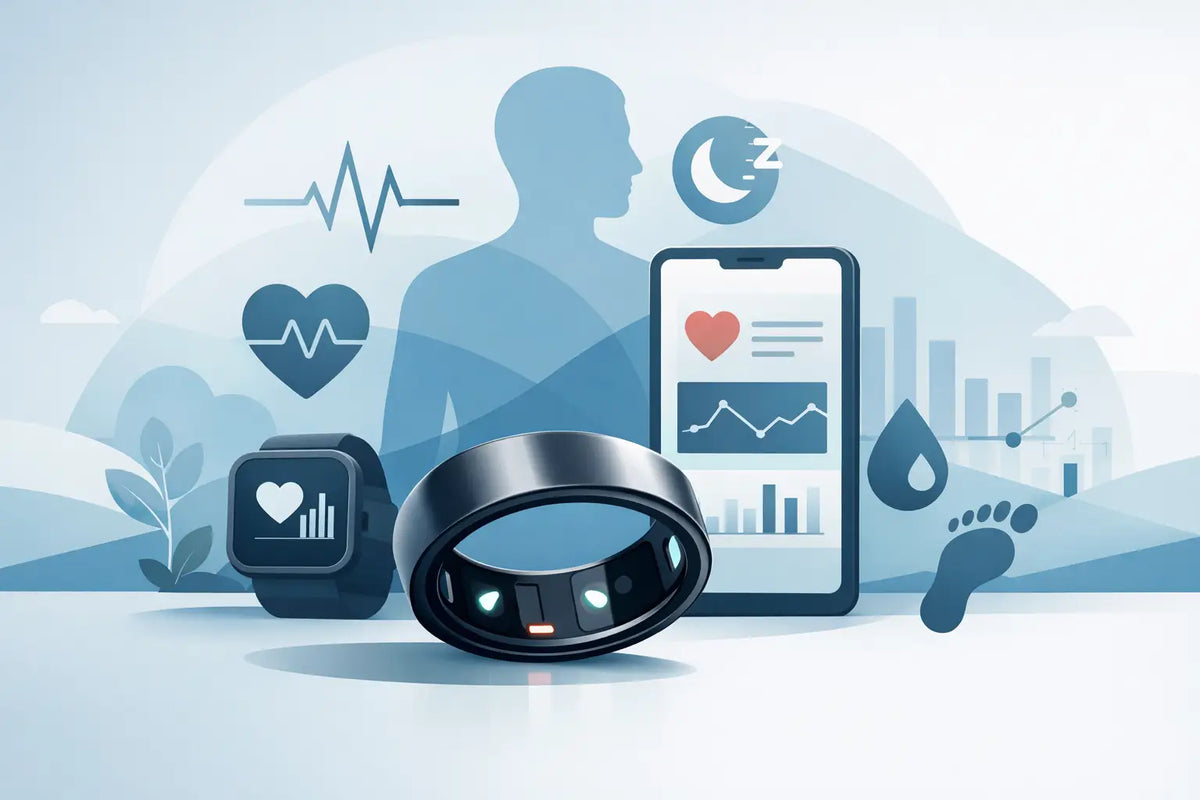
For health data, skin contact is what matters. Depending on the model, smart rings capture metrics such as heart rate, sleep stages, activity, temperature trends, and recovery using sensors on the inside of the ring. For these sensors to work consistently, the ring should not rotate freely or slip with every movement.
The best finger is therefore the one on which your ring stays still for many hours. This is especially true at night. Sleep data is one of the most valuable reasons for many people to wear a smart ring. If the ring pinches at night, causes you to take it off, or keeps spinning, you lose exactly the comfort that an unobtrusive tracker is designed to provide.
The dominant hand: practical or intrusive?
On the dominant hand, a smart ring can be more heavily used due to frequent gripping, typing, or carrying bags. This does not mean you should not wear it there. If it fits better and feels natural, that is a good reason.
Observe your typical routine: Do you work a lot on your laptop? Do you train with dumbbells? Do you cook often or work with your hands? During intense exertion or exercises involving a firm grip, it may be more comfortable to take the ring off briefly. This protects the ring and prevents pressure marks on your finger.
How to determine the right ring size
A smart ring should be able to slide over the knuckle with slight resistance. On the finger itself, it should fit securely without digging in. It should not pinch when opening and closing your hand. If it spins without resistance, it is probably too large.
Do not check the size only in the morning. Fingers change their circumference throughout the day. Heat, exercise, salty food, travel, and fluid retention can cause a ring to fit significantly tighter in the evening than in the morning. Therefore, test it at different times and ideally overnight as well.
A good practical test is simple: Wear the chosen size for at least one full day. Type, go for a walk, wash your hands, and sleep with it on. The ring should remain secure during normal movements but be easy to remove without pain.
The Fitorb Smart Ring Pro is designed for exactly this kind of everyday use: health metrics right on your finger, without a display, vibrations, or a bulky watch on your wrist. Use a ring-sizing tool before ordering if you are torn between two sizes. The right size is not a minor detail—it turns a beautiful ring into a tracker you will actually wear every day.
The pinky and the thumb: when they work
The pinky is not ruled out, but it is usually the second choice. It is narrower, the ring can slip more easily, and contact with the skin is less consistent during certain hand movements. However, if the pinky is your most stable finger and the ring fits comfortably there, it can be a personal solution.
The thumb stands out more and is constantly in motion when gripping. For some people, a ring fits surprisingly well there, while others quickly find it intrusive. Those who want a minimalist look or frequently type on their smartphone are usually better off with the index, middle, or ring finger.
The bottom line remains: comfort beats habit. Do not wear your smart ring on a finger just because it is expected visually. Health monitoring works best when the ring becomes part of your routine—in the morning with your coffee, during the day at the office, on walks, and at night in bed.
Properly aligning the sensors
Many smart rings have small sensor areas or a marking on the inside. These should be positioned on the underside of the finger, on the side facing the palm. Contact is generally more stable there, and measurements can be more consistent.
Occasionally check whether the ring has spun. This happens especially when your hands are wet, you have used cream, or the ring fits a little too loosely. A quick realignment is all that is needed. You do not need to check the ring constantly—but a correct starting position improves the chances of obtaining meaningful trends.
Skincare is also part of the process. Clean the ring and finger regularly with a soft, slightly damp cloth and dry both thoroughly. Residues of cream, soap, or sweat can affect comfort. Give your finger a break if the skin becomes irritated.
What applies to exercise, sleep, and the seasons
While sleeping, the ring may fit slightly tighter than a classic fashion ring, as long as it does not constrict. Hands and fingers move less at night, so a well-chosen finger often remains particularly stable. For many wearers, the index and middle fingers provide a very comfortable fit.
During exercise, it depends on the type of training. For running, yoga, walking, or cycling, the ring usually stays securely on the finger. For strength training, climbing, or sports involving a firm grip, it may be sensible to take it off. A smart ring does not need to capture every single minute of training if wearing it becomes uncomfortable.
In summer and after intense exercise, fingers can swell. In winter, they often become narrower. If your size is right on the borderline, be sure to test it after a walk or in the evening as well. A ring that appears perfect in the morning should not feel uncomfortably tight later.
If you are torn between two fingers
Do not automatically choose the finger with the tightest fit. The better choice is the finger on which the ring stays secure while remaining unobtrusive in everyday life. A slightly looser ring on the middle finger can be more comfortable and reliable than a ring that is too tight on the index finger.
Give yourself a few days if you have just switched from a smartwatch or no tracker at all. A ring feels different from a wristband. After a short adjustment period, most people quickly realize which finger feels right.
Your ideal finger is the one you do not constantly think about—but whose data you enjoy using. Test the fit in your real everyday life, not just in front of the mirror. Then a smart ring becomes a discreet companion that helps you manage your sleep, activity, and recovery more consciously.


Leave a comment
This site is protected by hCaptcha and the hCaptcha Privacy Policy and Terms of Service apply.