
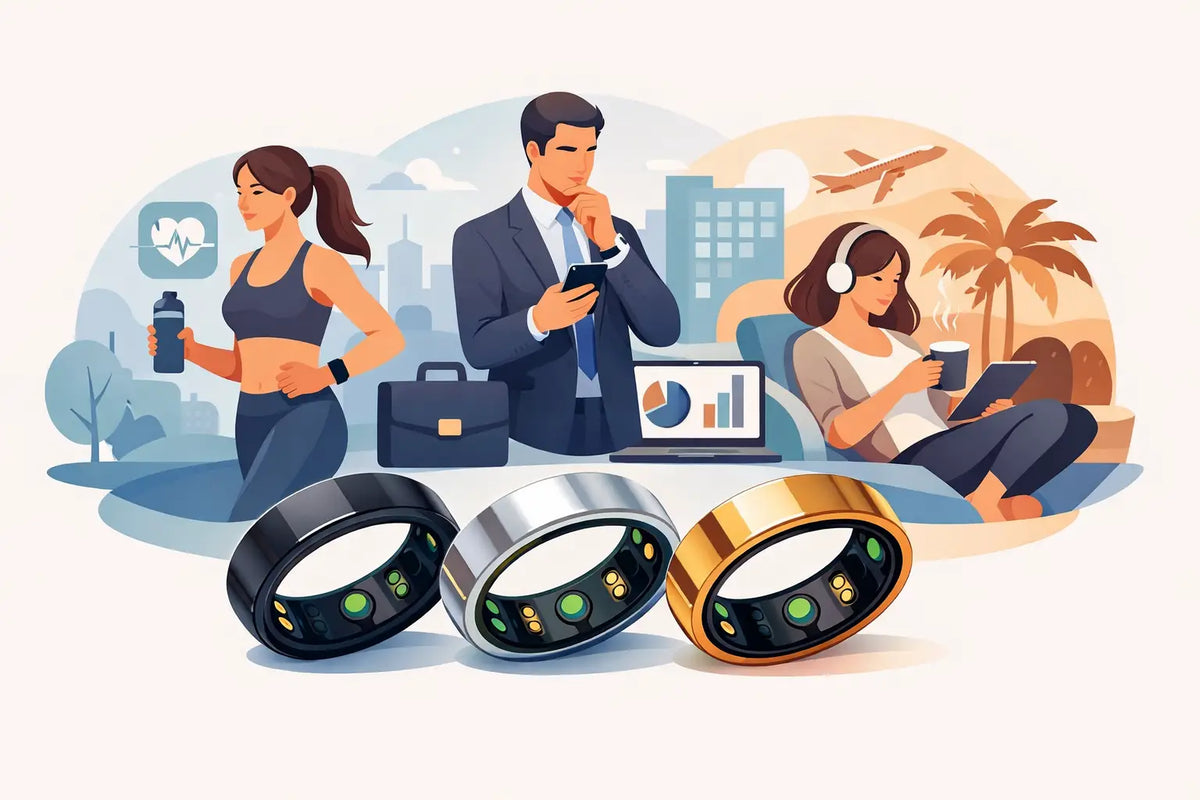
A smartwatch can vibrate during a meeting, disrupt your sleep, and quickly look too technical with your evening outfit. A smart ring takes a different approach: It discreetly collects health data directly on your finger while remaining an accessory that suits you. If you want to choose a smart ring that fits your lifestyle, you should therefore not only look at the sensors. The key is whether the ring can be worn naturally in the morning, at night, during exercise, and in quiet moments.
Your everyday life determines the right smart ring
The best smart ring is not necessarily the one with the longest list of features. It is the one you want to wear continuously. After all, sleep trends, recovery, and daily activity only become meaningful if the ring remains part of your routine for weeks and months.
First, ask yourself when you want to use your health data the most. Are you primarily trying to understand why you don't wake up feeling rested despite eight hours in bed? Then sleep analysis, wearing comfort, and reliable battery life are the priorities. If you want to integrate exercise more consciously into a busy workday, activity data, step goals, and an easy-to-understand app are particularly relevant.
If you are out and about a lot, you also need a model that does not constantly demand your attention. A ring without a display does not distract you with notifications. It records what matters while you work, exercise, travel, or unwind. That is exactly its advantage over a wearable that competes for attention around your wrist all day.
Understand sleep instead of just counting hours
For many people, the desire for a smart ring begins with a simple observation: sleep duration alone does not explain how fit you feel the next morning. A good ring helps make patterns visible. When do you settle down? How regularly do you sleep? How does a late meal, alcohol, stress, or intense exercise affect your night?
This is not about monitoring every metric. Health data should give you guidance, not create a new to-do list. Therefore, choose a smart ring whose analysis is clear and motivating. You should be able to see at a glance whether your body needs more rest, exercise, or a quieter evening.
The fit also plays a major role at night. A ring must not pinch, rotate, or be so loose that the measurement becomes inaccurate. Especially with sleep tracking, comfort is not a detail, but a prerequisite for actually wearing the ring every night.
For sleep optimizers, routine is key
If you want to improve your sleep, pay attention to a simple morning routine: open the app, view the development, and make a small decision. Maybe you plan a walk today instead of a hard workout. Maybe you put your smartphone away earlier. Small, repeatable adjustments usually bring more than trying to force perfect values.
Sporty active or simply more on the move?
A smart ring is not only suitable for people with a training plan. Those who work in an office, commute a lot, or have a busy family life also benefit from realistically assessing their activity. Steps, activity phases, and recovery values make visible how your day actually looks—not how active it felt.
For regular athletes, a ring is particularly interesting if a watch is practical during training but not worn during the rest of everyday life. The smart ring complements this routine: It discreetly accompanies sleep and recovery overnight and provides context for the next day's exertion. For precise live data during a run or bike ride, a sports watch may still be the better complement depending on your needs. This is not a disadvantage, but a question of usage.
During strength training, climbing, or working with heavy equipment, it may make sense to briefly remove the ring. This protects both the ring and your finger. For walks, yoga, everyday life, and many other activities, however, it remains pleasantly unobtrusive. The key is to choose a model that follows your habits instead of forcing you into different behavior.
Design is part of everyday use
A smart ring sits visibly on your hand. Therefore, it must not only be functional, but also feel right for you. Minimalist in silver, striking in black, or warm and elegant in gold—the right color often determines whether the ring disappears into your jewelry mix or deliberately makes a statement.
Consider which rings and watches you already wear. Someone who otherwise prefers delicate jewelry may not feel comfortable with a model that is too wide or conspicuous. Someone who likes a clear, modern look can wear a slightly bolder ring shape as a technical accent. The surface also counts: matte looks understated, shiny rather classic and present.
A good lifestyle smart ring combines both sides. It should not look like a medical device just because it collects valuable health data. At the same time, design should never take precedence over wearing comfort. A beautiful ring that causes discomfort will quickly end up in a drawer.
Size determines comfort and data quality
With a smart ring, the right size is particularly important. Unlike a bracelet, the fit cannot be spontaneously made tighter or looser. Fingers change their circumference depending on the time of day, temperature, exercise, and salt intake. A ring that fits perfectly in the morning may feel too tight in the evening—or vice versa.
Therefore, do not just measure once in passing. Ideally, try your size at different times of day and consciously move your hand while doing so. The ring should be able to slide over the finger knuckle with slight resistance, but not slip off on its own. If it constantly rotates, the wearing experience can suffer just as much as the measurement quality.
Digital ring measuring tools and an uncomplicated size exchange are practical. They remove the greatest purchasing uncertainty from the decision. At Fitorb, the size guide, a free exchange for the wrong size, and a 30-day trial period are included—which makes sense, because the fit only reveals itself in real everyday life.
Which finger is the right one?
Many people wear a smart ring on their index, middle, or ring finger. The best finger is the one on which the ring sits securely and does not restrict your movements. If you wear multiple rings, also make sure they do not rub against each other or interfere when grasping.
Realistically check the app, battery, and everyday suitability
A smart ring thrives on data, but also on how you access it. The app should be compatible with your smartphone and present values in an understandable way. You do not need to be a data professional to get something out of sleep phases, activity, and recovery. Good analysis translates measurements into clear indications and shows developments over several days instead of dramatically evaluating individual outliers.
Also check how the ring is charged and how well the battery life fits your routine. Several days of battery life is significantly more relaxed in everyday life than daily charging. Nevertheless: Every battery must eventually go to the charging station. Set a fixed moment for this, such as while showering, reading, or at your desk. This way, the ring will not be missing right when you wanted to observe it.
Water resistance is also a practical topic. Hand washing, rain, and everyday life should not cause any stress. For swimming, the sauna, or very demanding outdoor activities, a close look at the respective manufacturer specifications is worthwhile. A smart ring should relieve you, not require new precautions for every movement.
Choosing a smart ring that fits your lifestyle: The honest decision
If you are looking for a discreet alternative to a smartwatch, a smart ring is particularly strong. It suits people who want to understand their health better without occupying their wrist with a display, notifications, and daily charging. It also suits everyone who wants an accessory that works just as well in the office as in the gym or at dinner.
Perhaps a smartwatch is still the better choice if you need cards, messages, music control, or live values directly on your wrist during training. Perhaps both devices complement each other perfectly. The ring takes care of sleep, recovery, and unobtrusive tracking around the clock, while the watch only comes onto the wrist when you really want to use its display functions.
Do not make your choice based on which feature sounds the most spectacular. Choose the ring whose size fits comfortably, whose design you like to wear, and whose data helps you feel a little more conscious in everyday life. If a smart ring makes your sleep routine more understandable in the morning and still sits just as naturally on your hand in the evening, it has found its place in your lifestyle.



Leave a comment
This site is protected by hCaptcha and the hCaptcha Privacy Policy and Terms of Service apply.