

A ring that sits discreetly on your finger can capture an astonishing number of signals from your body. But how exactly does a smart ring measure sleep, heart rate, and activity? The short answer: with small sensors that continuously collect data and turn it into understandable trends. What matters is not only the technology in the ring, but also how well it fits and how you interpret the values in everyday life.
How exactly does a smart ring measure physical signals?
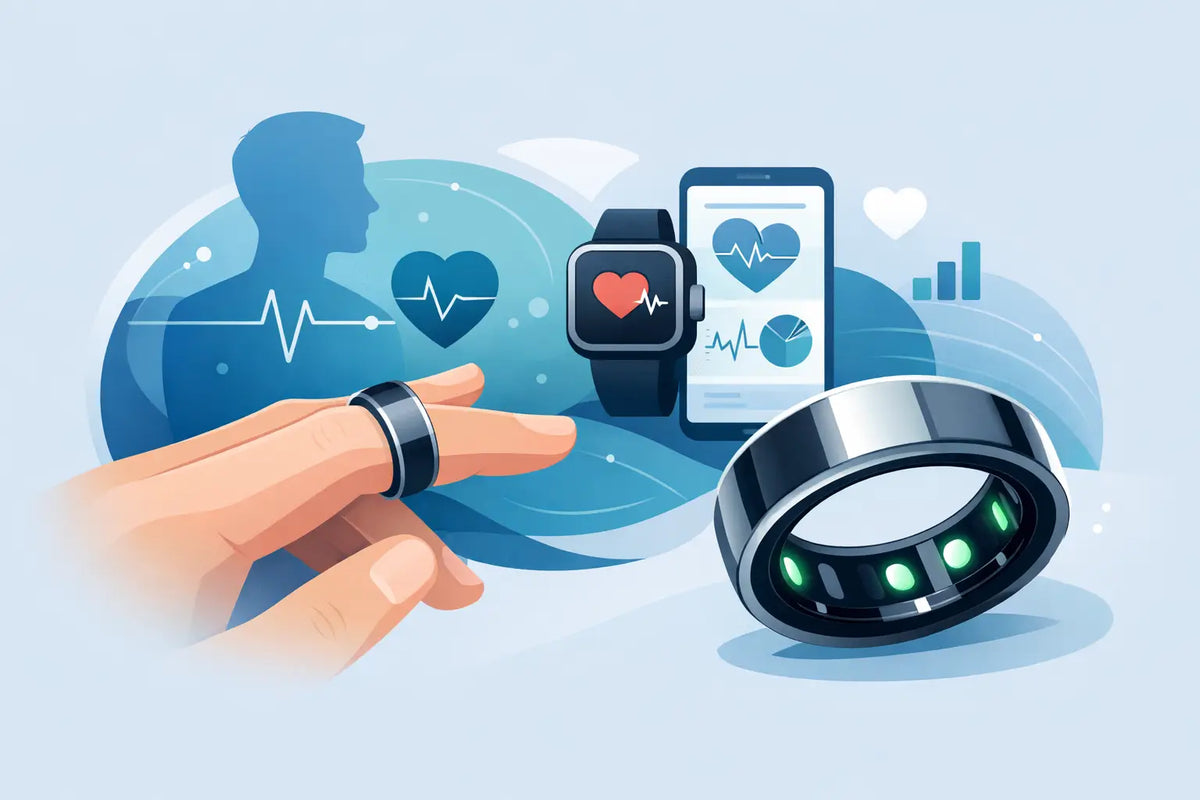
A smart ring does not simply measure health as a single number. It captures various physical and movement data and combines them into a complete picture. Depending on the model, optical sensors, motion sensors, and temperature sensors are used. The associated app prepares the measurements and shows you patterns, developments, and daily values.
The finger is a particularly useful place to measure. The blood vessels lie relatively close to the skin there, and a ring usually has stable contact if it is the right size. This can be an advantage, especially at night: no glowing display on the wrist, no bulky tracker while sleeping - instead, your health data right on your finger.
Heart rate: Light detects changes in blood flow
For heart rate and heart rate variability, many smart rings use an optical sensor. It sends light into the skin and measures how much of it is reflected back. With every heartbeat, the amount of blood in the small vessels of the finger changes. The sensor can detect these changes and convert them into heart rate values.
Heart rate shows how many times your heart beats per minute. Resting heart rate is often particularly meaningful, for example during the night or during quiet phases. If it is significantly higher than usual over several days, it can be due to poor sleep quality, intense training, stress, or the beginning of an infection. A single value, on the other hand, is rarely a cause for concern.
Heart rate variability, often referred to as HRV, looks at the fine time differences between heartbeats. It can give clues as to how well your body is currently coping with exertion and recovery. A higher or lower HRV is not generally good or bad. What matters is your personal trend - not the comparison with the values of other people.
Movement and temperature complete the picture
A motion sensor detects whether you are walking, sitting still, sleeping, or turning frequently at night. This creates activity data such as steps, active time, and estimated calorie consumption. Sleep phases are also not measured directly like in a sleep lab. Instead, the ring detects probable sleep and wake phases based on movement, heart rate, and other signals.
Many models also capture temperature changes on the skin. This usually refers to deviations from your personal baseline, not a clinical body temperature measurement. If the value rises or falls over several nights, it can be a useful indicator to pay closer attention to regeneration, sleep, and your own well-being.
What a smart ring can really measure in everyday life
The strength of a smart ring lies not in looking at a single moment, but in consistency. It accompanies you discreetly during the day and can collect data at night when many people do not want to wear a watch. This creates comparison values that become significantly more useful over time.
Regarding sleep, the ring usually analyzes sleep duration, wake times, movements, and the distribution of estimated sleep phases. From this, the app can derive a sleep score. This score is not meant to determine your morning. Rather, it helps you recognize connections: Do you sleep more restlessly after eating late? Does your recovery improve if you look at screens less in the evening? Does your body react to hard training days?
Regarding activity, it is about your daily rhythm. Steps and movement phases provide orientation, especially when a full day of work leads to a lack of exercise. Calorie consumption is always an estimate. Body height, weight, age, intensity of movement, and individual metabolic differences influence the result. Therefore, use it as a trend value, not as an exact basis for every meal.
How precise are the measured values of a smart ring?
A high-quality smart ring can provide very good everyday data, but it replaces neither a medical examination nor medical diagnostics. Its greatest strength is the observation of changes over days and weeks. If your resting heart rate, sleep duration, or activity level permanently deviate from your usual pattern, individual measurements become a helpful clue.
Accuracy depends on several factors. A ring should fit tightly but comfortably and turn as little as possible on the finger. If it is too loose, light from outside can interfere with the optical measurement, or the sensor temporarily loses skin contact. If it is too tight, it quickly becomes uncomfortable - especially when fingers swell slightly due to heat or after sports.
Cold hands can also influence values because blood circulation in the finger is lower then. Intense movements, strength training with a strong grip, sweat, dirt on the sensors, or an unfavorable position of the ring can also lead to deviations. For quiet measurements and sleep analysis, the conditions are often particularly good. For fast, varied sports, a chest strap is usually the more specialized choice for precise live heart rate.
Trends are more valuable than perfect individual values
Anyone who sees low recovery in the morning should not immediately cancel the whole day. First check the context: Was the night short? Did you drink alcohol, work late, or train unusually hard? A smart ring provides data, but your everyday life provides the explanation for it.
Tracking becomes useful when you compare similar days. For example, observe for two weeks how sleep time, resting heart rate, and your personal feeling of energy are connected. After that, you can specifically test small habits. Maybe an earlier end to the workday really brings you better sleep. Maybe a walk after eating does you good. Small adjustments are often more sustainable than radical plans.
How to get more out of your smart ring
Wear the ring as regularly as possible, especially at night. Only then can the app build a reliable personal baseline. Occasionally clean the sensor surface with a soft, slightly damp cloth and check if the ring still fits correctly after washing your hands or during sports.
Also pay attention to the right ring size. It is not a minor detail, but directly influences comfort and measurement quality. A digital ring size check or a size set can help avoid uncertainty before purchase. Ideal is a fit where the ring does not slip, but can be removed without pressure.
Do not just look at scores in the app. Combine data with your own feeling. If you feel exhausted despite good values or if you do not feel well for a longer period, a conversation with medical professionals is the right step. Wearables can make you more aware, but cannot make a diagnosis.
For whom is measuring on the finger worth it?
A smart ring is particularly well suited for people who want to better understand their health and habits without constantly looking at a display on the wrist. It is a stylish alternative for everyday work, for quiet nights, and for everyone who wants to take sleep and regeneration more seriously.
However, anyone who expects second-by-second live data on a large display during every training session will also appreciate a sports watch. This is not a disadvantage of the ring, but a question of use: The ring scores points with discretion, wearing comfort, and long-term insights into your everyday life.
The best measured value in the end is the one that helps you make a better decision. Wear your smart ring regularly, pay attention to your personal patterns, and give small changes enough time to show an effect.

Leave a comment
This site is protected by hCaptcha and the hCaptcha Privacy Policy and Terms of Service apply.