

Anyone wearing a smart ring for the first time usually realizes within a few hours why this format makes so many classic trackers look outdated. No display on the wrist, no bulky casing, no constant feeling of visibly carrying technology with you. That is exactly why many people ask the same question before buying: How does a smart ring work—and what can it really do in everyday life?
The short answer is: A smart ring is a compact sensor worn on the finger. It captures body and movement data, analyzes it via an app, and turns it into understandable insights about sleep, activity, recovery, and sometimes heart rate or stress levels. But the more interesting answer lies in the details. After all, whether a ring makes sense for your everyday life depends not only on the technology, but also on how discreetly, comfortably, and reliably it works.
How does a smart ring work technically?
Inside a smart ring is much more than you would expect from the outside. The narrow casing houses several mini-sensors, a battery, a wireless module, and a small processing unit. The ring fits snugly against the finger, which is a real advantage for many measurements. Certain values can be captured consistently and relatively stably at this point on the body.
The most important components include optical sensors, accelerometers, and temperature measurement. Optical sensors work with light. They send light pulses into the skin and detect how light reflection changes with blood flow. From this, the ring can derive, among other things, the heart rate. An accelerometer records movements, steps, rest periods, and sometimes training patterns. In addition, a temperature sensor measures small changes on the skin surface.
The data is not simply displayed in its raw form. The real added value only emerges through the software. The ring collects measurements throughout the day and night, transmits them via Bluetooth to the smartphone, and the app interprets patterns from them. Instead of just providing columns of numbers, it shows sleep phases, activity levels, or recovery trends.
What data does a smart ring measure?
Most people are not interested in sensor lists, but in a simple question: What exactly does it do for me? A smart ring is not meant to impress technically, but to help you better understand your body in everyday life.
Typical measurements revolve around sleep, movement, and heart rate. Many models detect when you fall asleep, how long you sleep, whether your sleep was interrupted, and how restful the night was overall. In addition, there are daily activity data such as steps, calorie consumption, or longer periods of inactivity. Depending on the model, resting heart rate, skin temperature, or recovery trends are also captured.
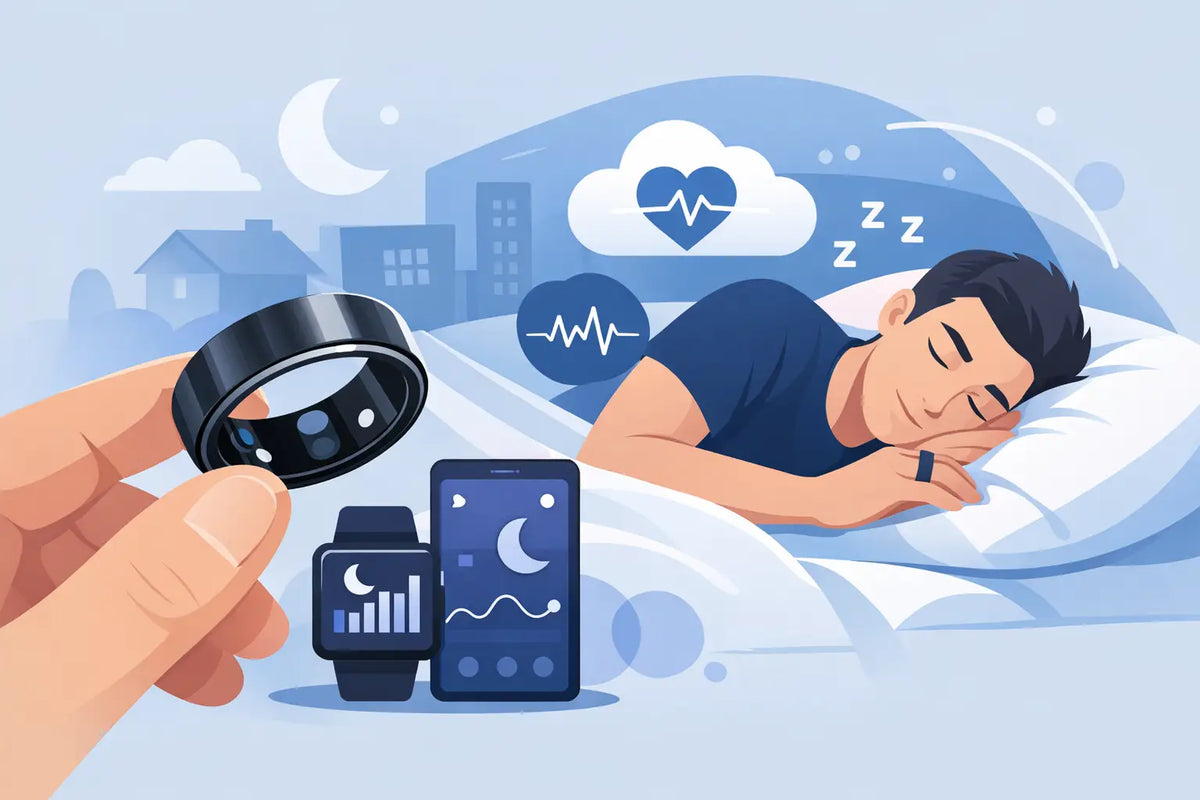
The advantage of a ring is particularly evident when it comes to sleep. Many people find a watch disruptive at night, especially larger models. A ring is barely noticeable while sleeping and therefore more likely to stay on the body permanently. And only what is worn regularly provides useful data.
Why does a ring on the finger often measure so well?
The question of how a smart ring works is closely linked to why the finger is such a sensible measurement point. The reason is simple: The ring sits close, securely, and permanently against the skin. This improves data collection for many biometric signals.
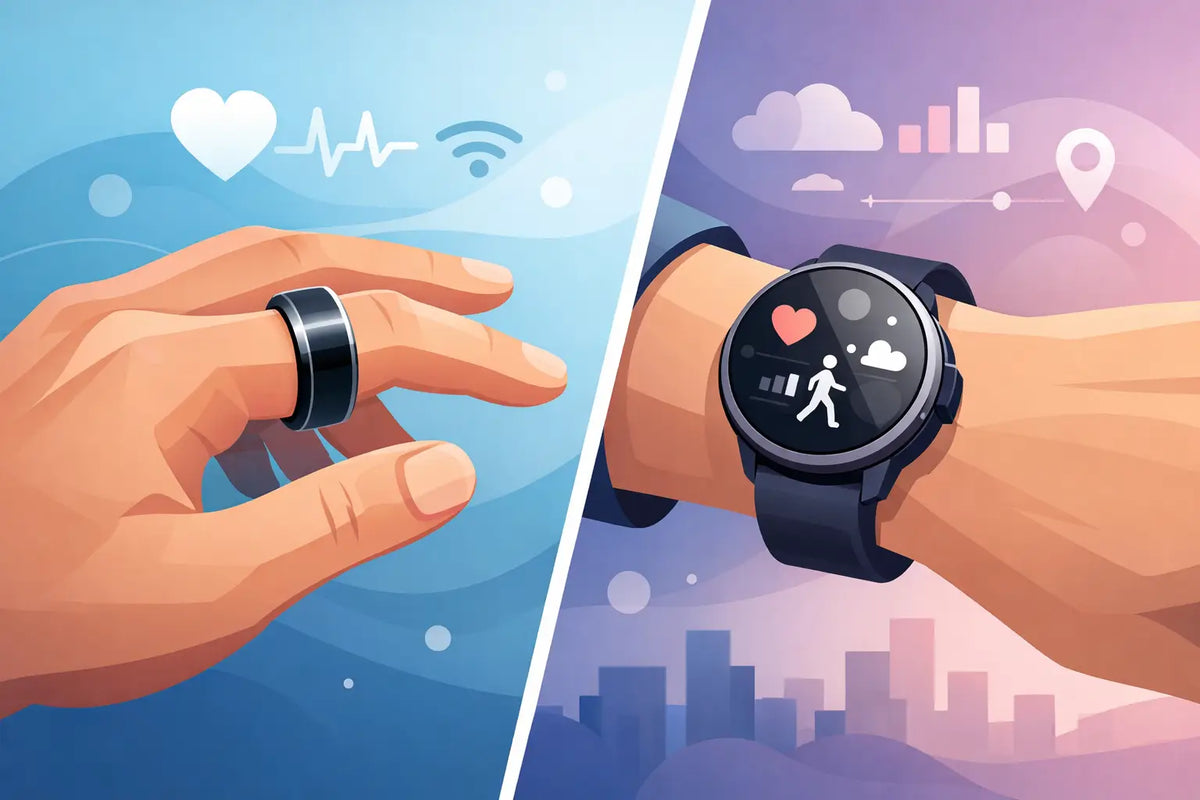
On the wrist, devices slip more easily, sometimes fit too loosely, or are taken off in between. A ring is often worn more consistently and moves relatively less. This can be particularly advantageous for sleep tracking and resting values. Nevertheless: Not every measurement is automatically medically accurate. Smart rings are primarily lifestyle and health companions, not a replacement for medical diagnostics.
This exact difference is important. Anyone who wants to better understand their habits, recognize sleep patterns, or keep an eye on daily activity will find a good smart ring to be a very practical tool for everyday life. Anyone expecting a clinical diagnosis, on the other hand, is setting the wrong expectation of the product.
How the app works with the ring data
The ring alone is only half the experience. Only the app turns sensor data into real guidance. It collects the values, displays trends, and translates them into understandable insights. That is the moment when technology becomes a useful product.
Instead of just showing that the heart rate was at a certain level during the night, the app can make connections visible. For example, that late eating, alcohol, little movement, or a restless week influenced sleep quality. Such patterns are often more valuable than individual daily values.
This is also where it is decided whether a smart ring will keep you motivated in the long term or become uninteresting after a few days. Good wearables make data easy to understand. No one wants to read half a manual in the morning just to understand whether the night was good or not.
What a smart ring does better in everyday life
A smart ring is particularly strong when technology does not look like technology. For many professionals, commuters, or people with an active everyday life, that is exactly the biggest plus. The ring discreetly accompanies meetings, sports, sleep, and leisure time without constantly being in view.
This makes it particularly attractive for people who do not want to wear a smartwatch. Some find watches disruptive during training, while others consciously do not want a glowing display on their arm. A ring appears significantly more understated and fits better with a minimalist style.
The topic of habits also plays a major role. Anyone who wants to improve their recovery, sleep, or daily activity does not need complicated technology, but a product that you actually wear. The less complicated the wearing, the more likely a short trial phase will become a real routine.
Where the limits lie
As elegant as the concept is, a smart ring is not superior to every smartwatch in every discipline. Anyone who wants to read messages, answer calls, or track training live on a display will not be happy with a ring alone. It is not a mini-smartphone for the finger.
In sports that place a strong strain on the hands, it also depends on personal perception. For example, during strength training, some wear the ring without any problems, while others prefer to take it off briefly. This is not a deficiency, but a question of comfort and the usage situation.
In addition, precision and range of functions depend on the respective model. Not every ring measures the same amount, not every app evaluates it equally understandably, and not every design fits equally well. The right size is particularly crucial, because the ring can only measure accurately if it fits comfortably and securely.
What you should look for when buying
If you want to understand how a smart ring works, you should not only look at the sensors, but at the overall package. The crucial thing is whether the ring fits your everyday life and whether the use really remains simple.
Pay attention to wearing comfort, battery life, water resistance, app usability, and sizing. A high-quality ring is worth little if it pinches or constantly needs to be charged. Equally important is a clear, easy-to-understand app that turns data into concrete insights instead of confusion.
For many buyers, size is the biggest hurdle. This is understandable, because a ring must fit more precisely than a watch. That is exactly why digital ring measuring tools or an uncomplicated exchange are so valuable. They significantly reduce the risk when buying online and make the decision more relaxed.
Anyone looking for a model that discreetly, stylishly, and practically captures health data usually looks not only at technology, but also at trust. A fair trial period, free shipping, and an easy size exchange are not secondary matters, but part of a good product experience. This is exactly where modern providers like Fitorb start.
For whom is a smart ring really worth it?
People who want to manage their health more consciously without wearing an eye-catching gadget benefit the most. If you want to sleep better, assess your activity more realistically, or simply understand how your everyday life affects your body, a smart ring is a very fitting solution.
It is particularly well suited to people who do not want to separate design and function. The ring should not look like a compromise, but like a product you enjoy wearing. That is exactly where its strength lies: health monitoring does not become a foreign body in everyday life, but a natural part of it.
Anyone looking for maximum smartwatch functions, on the other hand, may need a different device or a combination of both. So it is less about a blanket better or worse, but rather about the question of what kind of technology you will really use permanently.
A good smart ring does not simply give you more data. It gives you a clearer sense of how you sleep, how active you really are, and when your body needs recovery. And sometimes, this quiet form of technology is exactly the one that stays the longest.

Leave a comment
This site is protected by hCaptcha and the hCaptcha Privacy Policy and Terms of Service apply.